ActiveVital: Geometry-Aware Embodied Vital Signs Monitoring for Home Healthcare Robots
Home robots require reliable vital signs monitoring to support long-term companionship and safety in daily environments, yet obtaining respiration and heart rate without physical contact remains...
1. Introduction: The Challenge of Unconstrained Health Monitoring
As home robots transition from utilitarian tools to long-term health companions, their ability to monitor human physiology becomes a core safety requirement. Specifically, the non-contact extraction of respiration and heart rate is essential for enabling health-aware interactions and identifying emergency states. However, as Hu et al. identify in their paper, ActiveVital: Geometry-Aware Embodied Vital Signs Monitoring for Home Healthcare Robots, obtaining high-fidelity measurements in unconstrained domestic settings remains a significant technical challenge.
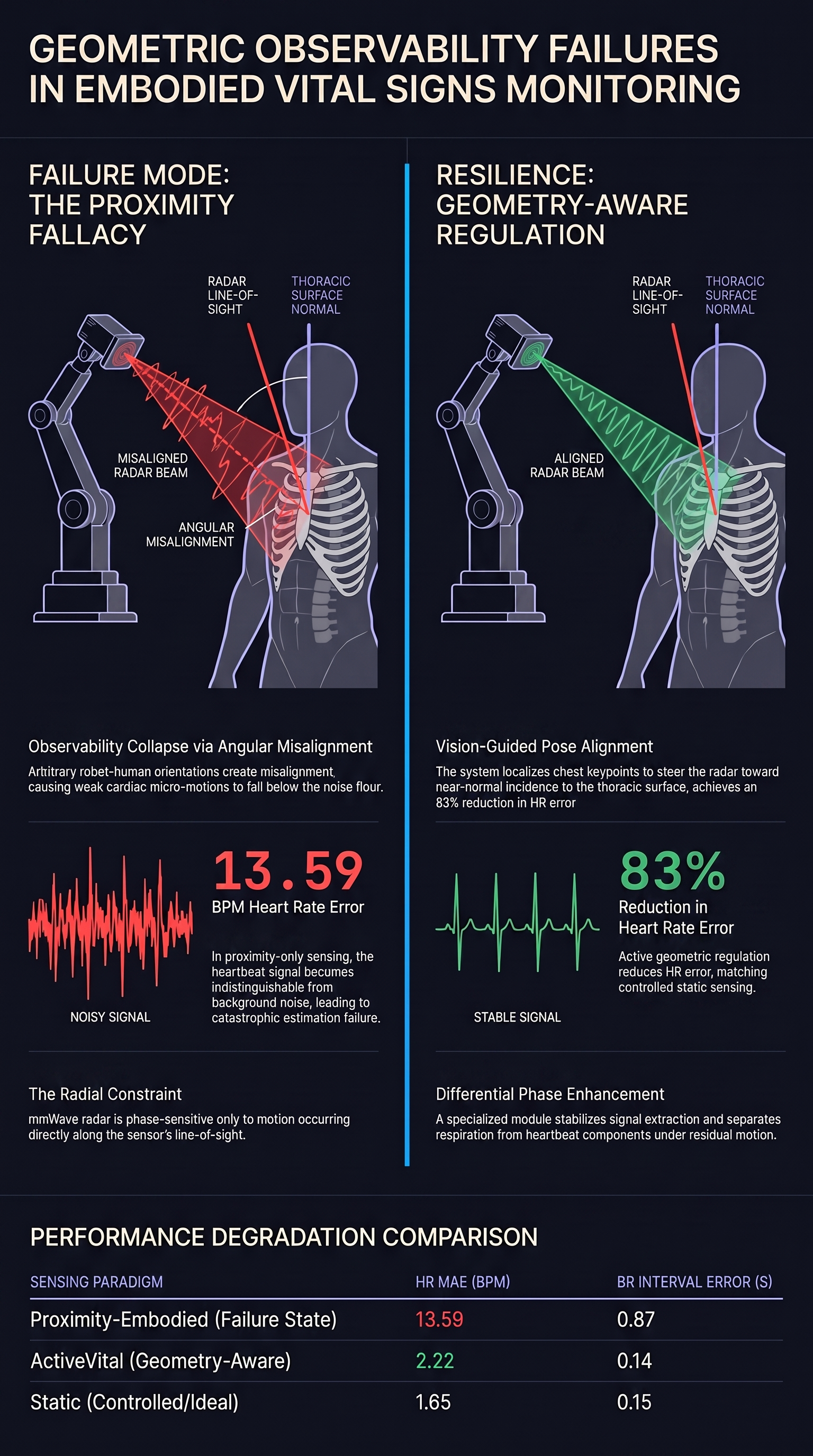
While millimeter-wave (mmWave) radar is highly sensitive to sub-millimeter thoracic motions, its performance is fundamentally limited by the observation geometry. In real-world environments where users are not deliberately aligned with a sensor, “angular misalignment” frequently leads to signal degradation. To resolve this, the authors propose ActiveVital, a framework that reformulates vital signs monitoring from a passive signal recovery task into an active, closed-loop geometric regulation problem.
Project Resources: yuxuanhu9.github.io/ActiveVital/
2. The “Radial Constraint” Problem: Why Passive Sensing Fails
The physics of frequency-modulated continuous-wave (FMCW) radar dictates that the sensor only observes displacement along its direct line of sight. This “radial constraint” means that any motion not parallel to the radar’s probing vector is attenuated by a factor of , where is the angle of incidence.
According to the Geometrical Theory of Diffraction (GTD) cited by the authors, the human chest is modeled as a finite set of dominant scattering centers. For the extremely minute displacements of a heartbeat (often sub-millimeter), even a slight angular misalignment can push the cardiac signal below the system’s noise floor. Passive systems fail because they treat this geometry as an external, unchangeable variable.
The following table contrasts the sensing paradigms analyzed by the authors:
| Sensing Paradigm | Characteristics | Observation Constraints |
|---|---|---|
| Static Sensing | Fixed sensor; focus on backend DSP. | Relies on explicit subject cooperation to maintain alignment. |
| Proximity Embodied | Mobile platform; prioritizes distance reduction. | Increases echo amplitude but ignores the attenuation of micro-motions. |
| ActiveVital (Proposed) | Active sensor pose regulation. | Treats sensor pose as a controllable variable within a perception-action loop. |
3. Technical Deep Dive: The ActiveVital Pipeline
The ActiveVital framework integrates vision-guided localization with a closed-loop control system to maximize the observability of cardiopulmonary motion.
Vision-Guided Chest Localization
The system employs ViTPose to extract four primary torso keypoints: shoulders () and hips (). The authors define the shoulder midpoint and hip midpoint to establish a torso axis. A “chest sensing anchor” () is then calculated via interpolation to target the upper-left thoracic region:
- Vertical Coordinate: (where )
- Horizontal Coordinate: (where and is the distance between shoulders)
Closed-Loop Pose Regulation
The robot treats the pixel deviation between and the image center () as an error signal . To prevent robotic oscillations caused by estimation noise—a critical safety consideration—the authors introduce tolerance thresholds . A binary control vector is generated: This control logic steers the radar toward a “near-normal incidence,” ensuring that the radar probing axis is perpendicular to the thoracic surface.
Phase Enhancement and Signal Processing
To handle the residual motion of a mobile robot, the authors implement a robust signal extraction module:
- Differential Phase Enhancement: The system applies first-order temporal differencing () to suppress low-frequency drift and enhance the visibility of micro-motions.
- Impulsive Noise Suppression: A Hampel filter identifies outliers using a robust scale estimate (Median Absolute Deviation). Samples exceeding a threshold are replaced by the local median, preventing false alarms often triggered by impulsive signal spikes.
4. Experimental Evidence: Quantifying Robustness Gains
The authors evaluated ActiveVital using a Galaxea R1 Lite robot and a 60 GHz FMCW radar. The results show that active geometry regulation substantially reduces error relative to proximity-only sensing (HR MAE 5.26 → 2.22 bpm), while approaching — but not matching — the accuracy of cooperative static sensing (1.66 bpm). Breath-interval error is essentially at parity with static sensing (0.14 s vs 0.15 s). No significance test is reported.
Table: Comparative Error Metrics Across Sensing Paradigms
| Metric | Static Sensing (Cooperative) | Proximity Sensing (Non-Cooperative) | ActiveVital (Proposed) |
|---|---|---|---|
| BI MAE (s) | 0.15 | 0.58 | 0.14 |
| BI RMSE (s) | 0.19 | 0.78 | 0.17 |
| HR MAE (bpm) | 1.66 | 5.26 | 2.22 |
| HR RMSE (bpm) | 1.96 | 6.59 | 2.59 |
Note: The 5.26 bpm figure above is the Proximity Sensing average across the full evaluation. In a separate baseline configuration using standard band-pass filters, the same paradigm’s HR error rose to 13.59 bpm (MAE) — indicating that the proximity paradigm’s error is highly sensitive to the choice of signal-processing back end, not only to sensing geometry.
The authors conclude that ActiveVital achieves accuracy comparable to controlled “Static” sensing, but without requiring the subject to adapt their posture or remain in a fixed location. This is an accuracy-parity result under the paper’s controlled indoor test setup — the study reports no clinical validation, patient cohort, diagnostic endpoint, or regulatory threshold, so “clinical-grade” would overstate what was measured.
5. Failure-First Analysis: Implications for AI Safety
From a safety and robustness perspective, this research highlights a silent “covert failure” mode in health-monitoring AI. In proximity-only or static systems, a robot may successfully track a target and capture a radar signal, yet provide highly inaccurate vital signs because the sensing angle is sub-optimal.
As shown in the paper’s spectral analysis, when angular misalignment occurs, the heartbeat peak becomes indistinguishable from the noise floor. A standard peak-tracking algorithm may return a spurious peak-based estimate instead of the true signal. This type of failure is silent; the system appears functional while providing faulty data — a downstream risk the study did not itself evaluate (it did not test emergency detection, diagnoses, alarms, or medical outcomes), but a plausible one if such data feeds a health-monitoring pipeline.
ActiveVital mitigates this by making sensing stability an explicit objective of the perception-action loop. By using anatomical priors to regulate pose, the system aims to keep the signal well above the noise floor. The study reports error distributions, not a deterministic guarantee.
6. Conclusion and Key Takeaways
The primary contribution of Hu et al. is the successful reformulation of physiological monitoring from a passive signal recovery task to an active geometric regulation problem. By treating the radar pose as a controllable variable, they demonstrate, in one controlled indoor test room with seated participants, that active pose regulation narrows the accuracy gap to cooperative static sensing — a result that has not yet been shown to generalize to complex, unconstrained domestic environments.
Practical Deployment Takeaways:
- Anatomical Priors are Essential: Effective robotic sensing requires more than generic “person tracking”; systems must understand human skeletal geometry to target specific anatomical anchors (e.g., the upper-left chest).
- Pose Regulation vs. Proximity: Simply moving a robot closer to a user is insufficient for micro-motion detection. In this study’s tested setup, the angle of incidence was a substantial factor in signal observability — the paper does not establish it as dominant over distance, multipath, motion, clothing, or algorithm choice in general.
- Robust Scale Estimates: In this pipeline, the Hampel filter with -based scale estimates helped prevent impulsive outliers from triggering false positives; the paper does not establish this as necessary across other systems.
Looking forward, the authors envision healthcare robots as “opportunistic” monitors—autonomous agents that provide background health oversight without the need for wearable devices or rigid user cooperation.
Read the full paper on arXiv · PDF