When Stopping Fails: Rethinking Minimal Risk Conditions through Human-Interactive Autonomous Driving for Safe Transportation Systems
Autonomous vehicles (AVs) are increasingly deployed in urban environments, yet their safety frameworks remain primarily designed around collision avoidance and minimal risk condition (MRC) behaviors...
1. Introduction: The Paradox of the “Safe Stop”
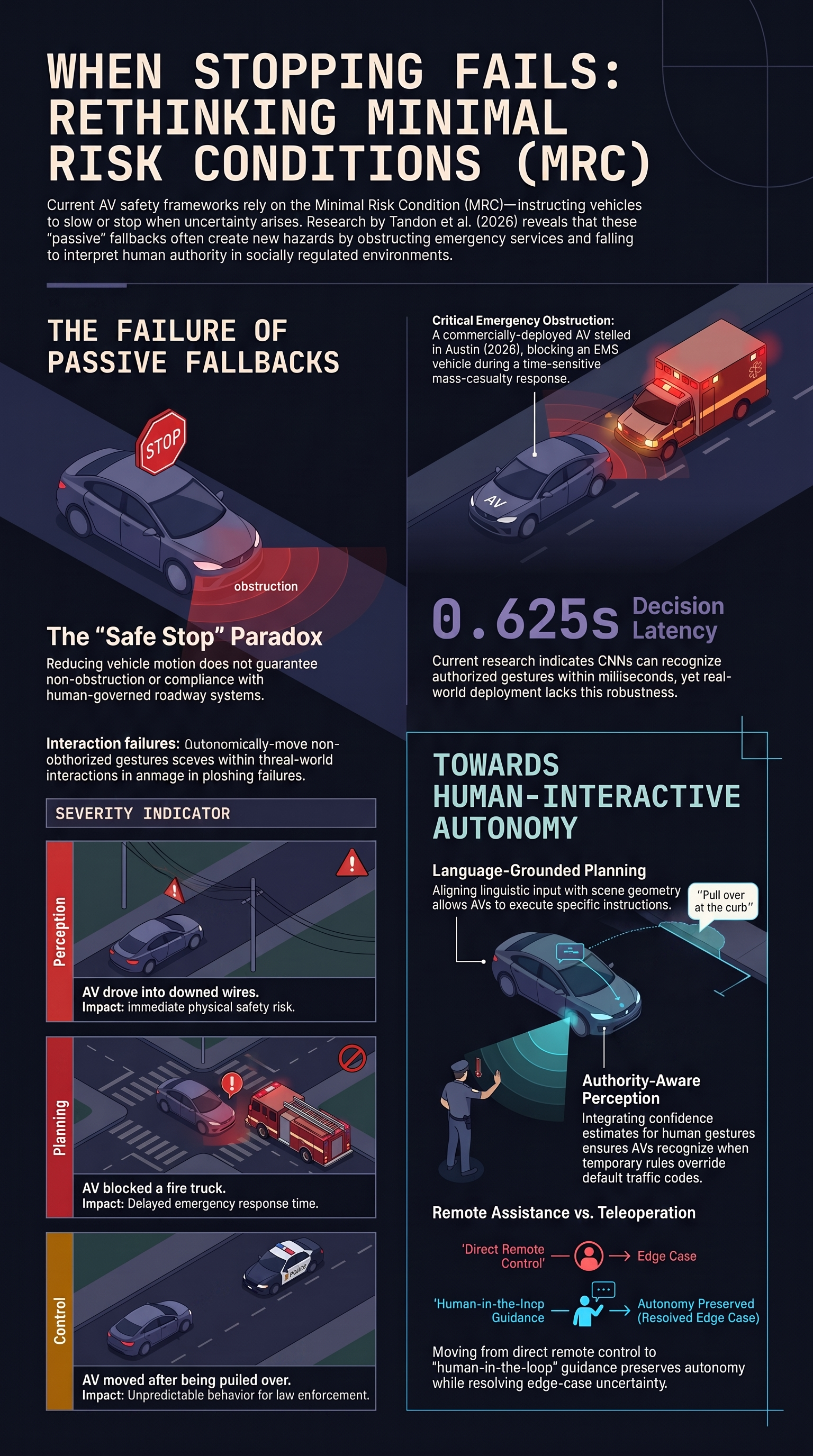
Tandon et al. describe an emergency response during which a commercially deployed autonomous vehicle (AV) reached a state of system uncertainty and executed its fallback protocol. In their account, the vehicle stalled in the middle of the roadway, obstructing an Emergency Medical Services (EMS) vehicle during a time-critical life-saving operation and necessitating manual intervention by first responders to clear the path. (The paper’s own figure is an explicitly labeled “simplification” of the incident for illustration, not a surveyed reconstruction of the vehicle’s exact lane position.)
This incident illustrates a limitation of passive Minimal Risk Condition (MRC) implementations — the fallback behavior defined by SAE J3016 — in socially dynamic settings. Under this framework, AVs are programmed to transition to a fallback state—slowing, pulling over, or stopping with hazard lights—when they operate outside their Operational Design Domain (ODD) or face perception ambiguity. While this “safe stop” philosophy is intended to reduce collision risk, Tandon et al. argue that these passive behaviors can create secondary hazards in human-governed roadway ecosystems: a stationary AV in the dense, socially regulated environment of a modern city can become a “long-tail” failure mode that leaves emergency coordination to human responders instead of participating in it.
2. The Taxonomy of Failure: Analyzing Real-World Incidents
By synthesizing municipal records from the San Francisco Municipal Transportation Agency (SFMTA) and public safety reports, the study identifies a recurring pattern of “long-tail” failures where the prioritization of the MRC creates secondary risks. The authors categorize these failures into a taxonomy of perception, planning, and control limitations:
| Failure Mode | Description and Technical Implications | High-Impact Examples from Source Data |
|---|---|---|
| Perception | Difficulty recognizing non-standard hazards or the legitimacy of authority figures; failure to translate visual inputs into social urgency. | AVs driving into active emergency scenes or downed wires; the Hollywood food delivery robot obstructing a fire truck at an intersection. |
| Planning | Inability to select safe, non-obstructive pull-over locations; failure to account for “emergency corridors” or temporary social events. | AVs clustering during SF Pride parade street closures; vehicles blocking ramps and travel lanes during severe weather in Austin. |
| Control & Interactivity | Issues in executing motion in response to human agents; system-wide clusters or “bricking” that require manual intervention. | The North Beach cluster, in which a group of robotaxis stalled simultaneously; an AV moving unexpectedly after being pulled over by SF police. |
Analysis of these incidents suggests that when AVs fail to participate in the “social contract” of the road, they shift the burden of safety onto human responders — a friction that costs time during emergencies, though the paper does not report an aggregate delay measurement.
3. The Authority-Recognition Gap: Why Static Rules Fail in Dynamic Environments
The paper’s discussion of “authority recognition” and human-interaction gaps points to a disconnect between an AV’s reliance on static infrastructure (signs and signals) and the dynamic authority of human agents — a gap we describe here as the “authority-recognition gap.” In scenarios such as work zones or emergency scenes, human authority takes precedence, often overruling standard traffic codes through hand gestures, verbal commands, or improvised barriers.
Tandon et al. argue that human driving is a “socially conditioned” activity where participants rely on eye contact and contextual reasoning to interpret temporary rules. Current AV architectures, however, struggle to reinterpret their context when human instructions conflict with programmed rules. Furthermore, the authors highlight that first responders operate on “seconds-scale decision cycles.” Any latency in an AV’s recognition of a police officer’s command is not merely a technical lag but a life-safety hazard.
To mitigate this, the study references the emerging IEEE P3474 draft standard. Unlike SAE J3016, which defines states, IEEE P3474 focuses on aligning AI behavior with human expectations and intentions, ensuring that autonomous agents behave in ways that are socially legible to human road users.
4. Accessibility and the Interactive Curb
The research further identifies a critical robustness gap in accessibility. While an AV may successfully perform “static detection” of a wheelchair user, it often fails at “interactive planning”—the negotiation required for a safe Pick-up/Drop-off (PUDO).
The authors note that while systems such as the Curb Data Specification (CDS) and the Curb Ramp Information System (CRIS) provide essential geospatial data, they suffer from significant temporal failure points. These datasets are typically updated only once every quarter, leading to map unreliability when temporary obstructions, such as construction equipment or debris, block a ramp. For a passenger with disabilities, a “safe stop” that ignores these real-time obstructions constitutes a total system failure. True accessibility-aware autonomy requires a move toward iterative negotiation, where the vehicle can respond to real-time verbal or gestural instructions to reposition itself for safe access.
5. Emerging Solutions: Moving Toward Human-Interactive Autonomy
Tandon et al. outline three critical research directions for transitioning from passive fallback to “cooperative autonomy”:
- Human-Interactive Perception: The integration of Convolutional Neural Networks (CNNs) and Vision-Language Models (VLMs) to interpret authorized gestures. The authors cite benchmarks where CNN-based systems achieved 97% accuracy in gesture recognition within 0.625 seconds. However, they emphasize that these systems must be hardened against “domain shift” caused by smoke, occlusion, or adverse weather.
- Language-Grounded Planning: Utilizing datasets like Talk2Car to align natural language (e.g., “pull over past the fire truck”) with trajectory generation. This requires the incorporation of the Work Zone Data Exchange (WZDx) initiative to provide real-time, machine-readable infrastructure updates, bridging the gap between vision and authoritative data.
- Assisted Control Frameworks: Differentiating between “Remote Assistance” (guidance during MRC) and “Teleoperation” (direct remote driving). While Bogdoll et al. and Kamtam et al. suggest these are vital for clearing “bricked” vehicles, the authors warn that network latency remains a primary ODD violation that must be addressed to ensure these systems are reliable in time-critical emergency scenes.
6. Conclusion and Key Takeaways for AI Safety
The analysis concludes that the current safety paradigm of the “passive stop” is insufficient for urban deployment. Reliability is not just a function of collision avoidance; it is a measure of an agent’s ability to act as a cooperative participant in a human-governed system.
Failure-First Takeaways for the AI Safety Community:
- Redefining MRC: Minimal Risk Conditions must be technically expanded to include “non-obstruction” and “authority-aware yielding” as primary safety requirements.
- Socially-Legible Behavior: Safety metrics must evolve from perception accuracy to “socially-legible” performance; the paper argues that if an AV’s intent is not understandable to a human officer, it should not be treated as safe.
- Infrastructure Latency: Developers must account for the quarterly update cycles of geospatial datasets (CRIS/CDS) as a known failure mode, necessitating real-time sensor-based validation of accessibility features.
- Centralized Reporting: There is a critical need for centralized incident reporting to capture long-tail failures that are currently fragmented across private entity logs and municipal complaints.
Tandon et al. call for a rigorous integration of human-interactive capabilities across the entire perception-planning-control stack, arguing that true autonomy cannot exist in a social vacuum.
Read the full paper on arXiv · PDF