RS-Diffuser: Risk-Sensitive Diffusion Planning with Distributional Value Guidance
Offline reinforcement learning enables policy learning from fixed datasets without additional environment interaction, making it appealing for safety-critical applications where online exploration is...
1. Introduction: The Risk-Neutrality Gap in Offline RL
Offline reinforcement learning (RL) offers a viable pathway for training autonomous agents using static datasets, thereby circumventing the safety risks and high costs of online exploration. However, as noted by Gong et al., a fundamental challenge persists in the form of “distributional shift.” When an agent encounters states or transitions with low support in the training data, standard policies often produce unreliable value estimates, leading to catastrophic failure during real-world deployment.
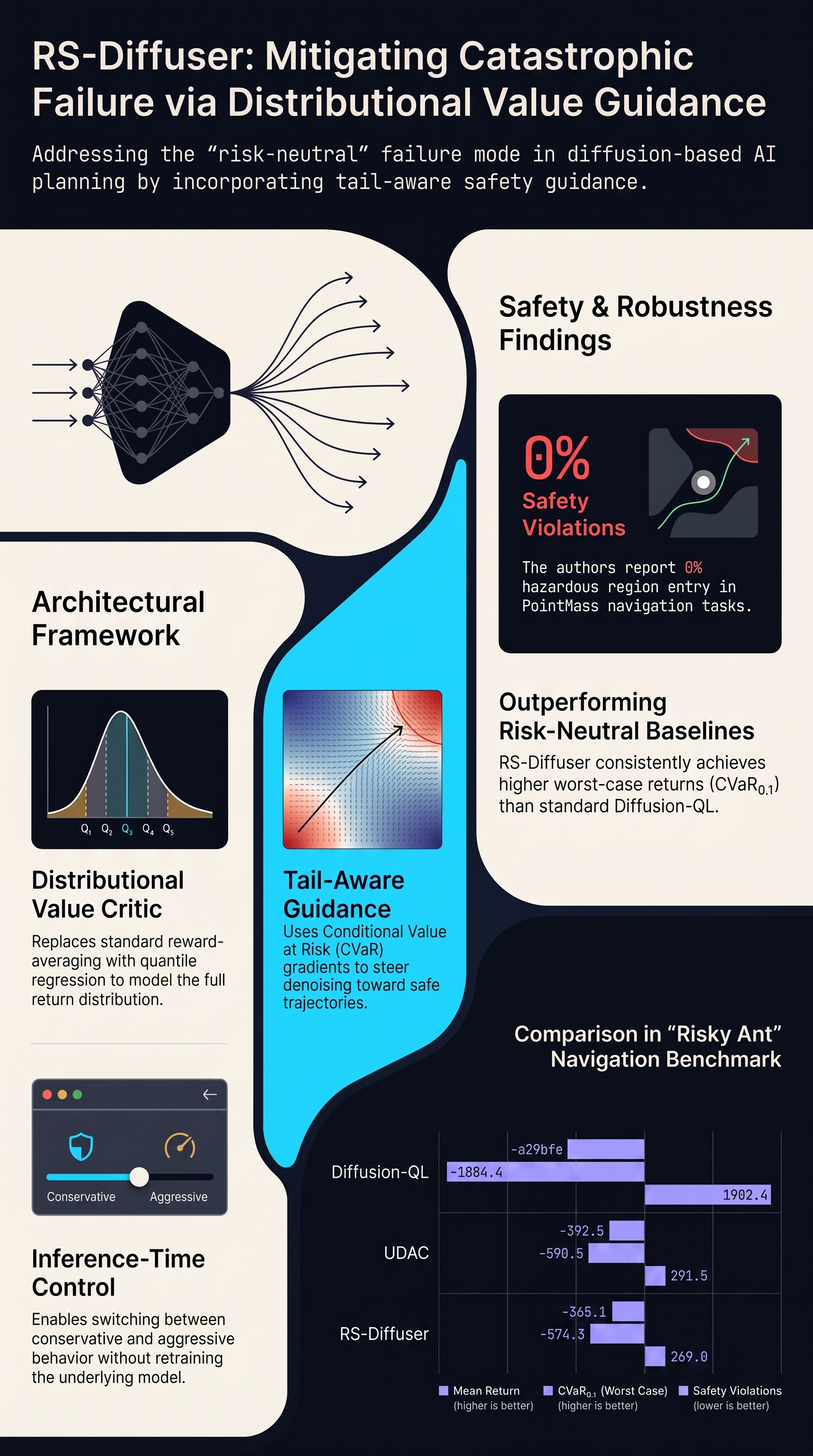
A critical vulnerability identified in current diffusion-based planners is their inherent “risk-neutrality.” Most existing architectures optimize for expected returns, effectively ignoring the “tail behavior” of the return distribution. In safety-critical applications like robotics or autonomous driving, two trajectory candidates may possess identical expected returns while differing drastically in their downside risk. Relying on mean-value optimization can cause an agent to overlook rare but devastating outcomes. To address this, the paper introduces RS-Diffuser, a framework that integrates generative diffusion planning with distributional value critics to produce controllable, risk-aware trajectories.
2. The RS-Diffuser Architecture: A Three-Pillar Approach
The RS-Diffuser framework employs a three-pillar architecture designed to decouple high-level planning from low-level execution. A key safety advantage of this “state-only” formulation is that it separates “what” should happen (the trajectory) from “how” it happens (the actions). By focusing solely on state evolutions, the diffusion model avoids being “distracted” by high-frequency action noise, which is a primary driver of distributional shift in standard offline RL.
| Component | Functional Role | Training Objective |
|---|---|---|
| Diffusion Planner | Models multimodal future state trajectories . | Minimizes the denoising objective to learn a state-trajectory prior. |
| Inverse Dynamics Model | Decodes planned state transitions into executable actions . | Supervised regression mapping to for stable action recovery. |
| Monte Carlo Distributional Critic | Estimates the full return-to-go distribution via quantile regression. | Minimizes Quantile Huber Loss using Monte Carlo return samples. |
The use of an Inverse Dynamics Model serves as a specialized tool for safety, providing more stable action decoding than methods that attempt to generate state-action pairs simultaneously.
3. Mechanism: Distributional Guidance and Inference-Time Control
The technical core of RS-Diffuser is its Monte Carlo Distributional Value Guidance. Unlike standard planners that utilize scalar value estimates, the RS-Diffuser critic approximates the return distribution as a uniform mixture of discrete Dirac masses (quantiles): .
To train this critic, the paper utilizes the Quantile Huber Loss: This approach uses Monte Carlo supervision (direct returns from the dataset) rather than Bellman bootstrapping. According to the paper, this avoids the instabilities and overestimation errors typically introduced by bootstrapping, which are major sources of failure in offline settings.
Risk-Sensitive Guidance Objectives
During the denoising process, gradients from the distributional critic steer the trajectory generation. The paper defines two primary risk-sensitive objectives based on the index sets of quantiles:
- Risk-Averse (Lower-Tail CVaR): This objective maximizes the average of the worst-case outcomes by targeting the lower quantiles.
- Risk-Seeking (Upper-Tail Objective): This objective encourages the pursuit of high-variance, high-reward paths by targeting the upper quantiles.
Inference-Time Advantage
A significant contribution of this work is that the planner is trained only once. By adjusting the risk parameter at inference time, a practitioner can toggle the agent’s behavior between risk-averse, neutral, or seeking profiles without retraining the core model.
4. Empirical Validation: Benchmarking Robustness and Safety
The authors evaluated RS-Diffuser using two benchmarks designed to highlight tail-end risks.
Risk-sensitive D4RL: To simulate “rare but catastrophic” events, the authors introduced stochastic penalties into MuJoCo environments:
- Half-Cheetah: Penalties for exceeding velocity thresholds.
- Walker2D & Hopper: Penalties for stability violations (e.g., excessive pitch angles).
Risky Robot Navigation (PointMass and Ant): In these tasks, the shortest path to a goal traverses a hazardous region. The results from the Risky Ant task (Table 2) demonstrate the framework’s superiority in identifying and avoiding these high-penalty zones:
| Algorithm | Mean Return | CVaR0.1 Return | Violations |
|---|---|---|---|
| CQL | -967.8 | -1887.3 | 1854.3 |
| Diffusion-QL | -892.5 | -1884.4 | 1902.4 |
| RS-Diffuser | -365.1 | -574.3 | 269.0 |
RS-Diffuser achieved the highest returns and significantly fewer safety violations compared to baselines, suggesting that modeling the full return distribution is more effective for safety than standard value estimation.
5. Failure-First Perspective: Robustness and Deployment Implications
From a safety research perspective, RS-Diffuser addresses the epistemic uncertainty inherent in limited offline data. In “Mixed” or complex datasets, trajectories are often non-Gaussian and multimodal. Because the planner is a generative diffusion model, it can represent these complex distributions more faithfully than Gaussian policies.
The ablation study in Section 5.4 demonstrates that varying creates a direct trade-off between mean performance and worst-case robustness. The authors argue that modeling the “tail” allows the agent to effectively “know” when it is entering a low-support, high-risk area of the dataset. By prioritizing the lower tail (), the system provides a mathematical defense against distributional shifts that would otherwise lead to safety violations.
6. Conclusion and Key Takeaways
The research by Gong et al. establishes RS-Diffuser as a robust framework for failure-resilient AI. By combining the expressive power of diffusion planning with the risk-awareness of distributional critics, the paper provides a methodology for deploying embodied agents in environments where “average” performance is an insufficient metric for success.
Key Takeaways for Practitioners:
- Efficiency of Inference-Time Tuning: Risk profiles can be adjusted during deployment without retraining, allowing for rapid adaptation to changing safety constraints.
- Distributional Superiority: Quantile regression provides a more robust signal for safety than standard mean-value estimates, particularly in identifying rare failure modes.
- Monte Carlo Stability: Avoiding Bellman bootstrapping in the critic training reduces the overestimation bias that often leads to safety failures in offline RL.
- Tail-Awareness as Defense: Explicitly modeling the tail behavior of returns is essential for mitigating the risks associated with epistemic uncertainty and data gaps in safety-critical robotics.
Read the full paper on arXiv · PDF