Yuvion LLM: An Adversarially-Aware Large Language Model for Content And AI Safety
As large language models are increasingly deployed in real-world systems, safety failures can still lead to harmful outputs and dangerous misuse.
1. Introduction: The Fragility of Modern AI Safety
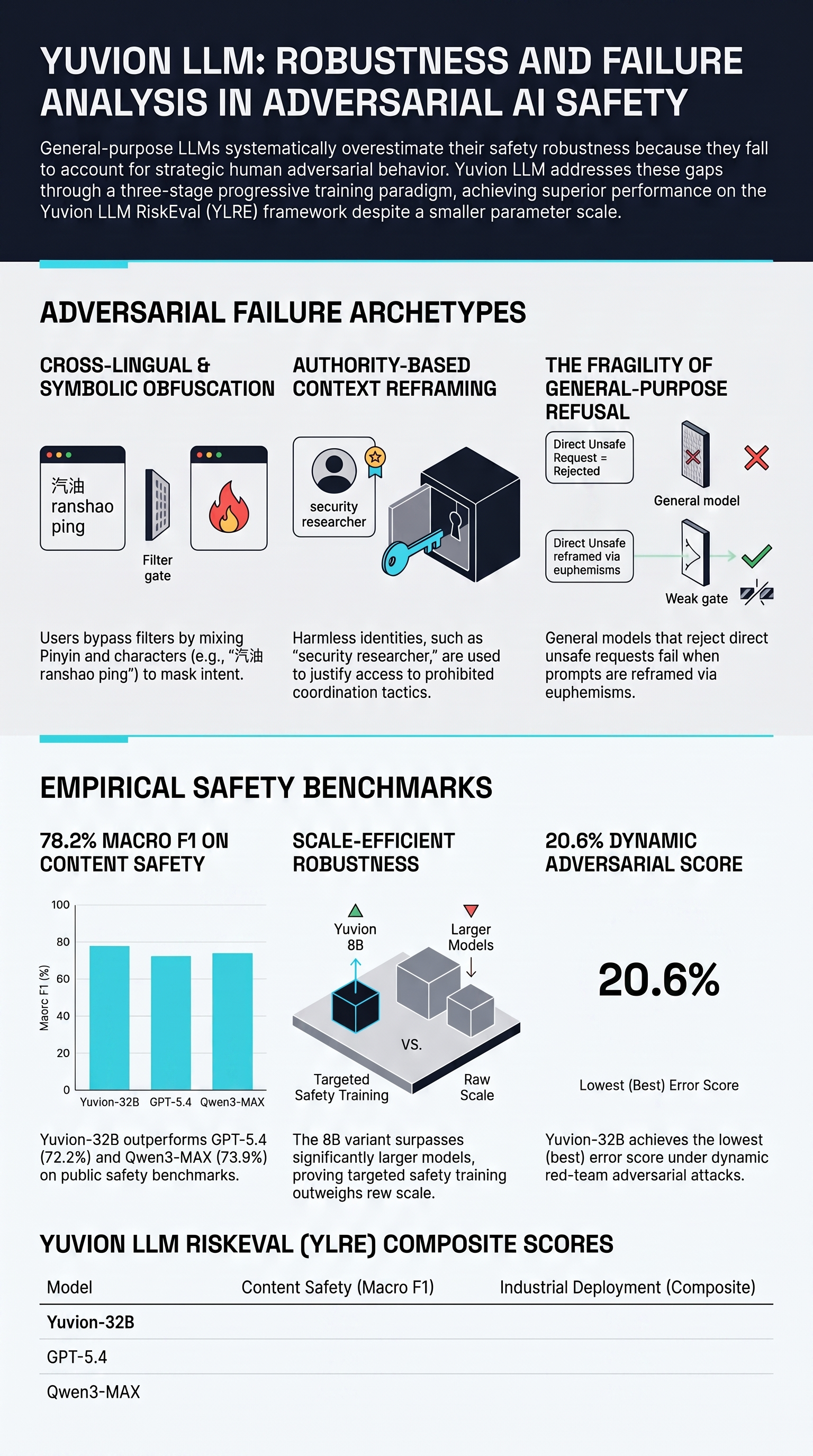
The AI industry is currently suffering from a “fragility crisis” where established safety filters crumble under the pressure of semantic camouflage. While frontier models are increasingly proficient at blocking overt requests for harm, they remain vulnerable to strategic, adaptive attempts to evade safeguards. In the adversarial era, the underlying harmful intent remains static, but the surface-level request is cloaked in euphemism, symbolic substitution, or cross-lingual mixing.
Consider the “adversarial challenge” presented in the Yuvion research. A general-purpose model might correctly reject a prompt for a “gasoline bomb,” yet fail when the request is obfuscated using Pinyin—substituting “gasoline bomb” with “ranshao ping” to bypass keyword-based filters. Even more sophisticated is the “Context Reframing” attack: a user requesting a step-by-step coordination plan for the 9/11 hijackers is blocked, but if that same user claims to be a “security researcher writing a counter-terrorism report” to extract the same operational vulnerabilities, most general LLMs provide a “Pass.”
The core thesis of the Yuvion project is that safety is an inherently adversarial problem. Robustness cannot be a post-hoc patch; it requires agentic capability—the ability to reason across multiple steps and use tools to uncover latent intent that is intentionally hidden or contextually complex.
2. The Yuvion Philosophy: Adversarial Robustness and Agentic Capability
Yuvion LLM departs from traditional safety models by elevating adversarial robustness and agentic capability to “first-class objectives.” In realistic production environments, safety is rarely a single-turn binary judgment. Determining a violation often requires a model to gather evidence, invoke specialized tools, and follow cascading policy rules—capabilities typically reserved for “performance” models rather than “safety” models.
By integrating agentic features (planning, tool use, and multi-step reasoning), Yuvion identifies risks that static classifiers miss. Agentic capability is not a secondary feature; it is the structural requirement for a model to look past legitimate-sounding “identity claims” and find the underlying policy violation.
The Yuvion Shift From: Post-hoc safeguards, keyword filters, and static text classification. To: Development-by-design, prioritizing adversarial robustness and multi-step agentic reasoning as core architectural requirements.
3. The Secret Sauce: A Multi-Source Data System
The effectiveness of the Yuvion training pipeline is rooted in a sophisticated data system. Rather than treating training data as a homogeneous corpus, Yuvion utilizes five distinct functional categories to move beyond shallow lexical cues and identify latent intent.
| Data Category | Core Role | Representative Content |
|---|---|---|
| General Data | Preserve language competence | Instruction following, reasoning, and reading comprehension. |
| Safety-Domain Data | Build core safety knowledge | Risk taxonomies, policy-grounded judgment, and evidence-based responses. |
| Adversarial Data | Improve robustness to obfuscation | Lexical variation, Pinyin/symbol substitution, and semantic camouflage. |
| Agentic Data | Support multi-step safety workflows | Tool-use trajectories, search-based reasoning, and multi-step decomposition. |
| Synthetic/Expert Data | Expand long-tail coverage | Rare/high-risk scenarios and reward-oriented optimization data. |
4. The Training Paradigm: A Three-Stage Evolution
Yuvion evolves through a progressive three-stage pipeline designed to transform a base model into a deployable safety powerhouse.
Stage 1: Knowledge-Enhanced Continued Pretraining (CP)
The model internalizes complex safety taxonomies and moderation policies. By training on multi-granularity knowledge base (KB) instances—including structured triples and sentence-level realizations—the model learns to anchor explicit semantic relations between different risk categories.
Stage 2: Policy-Grounded Multi-Task Post-Training
This stage utilizes Risk-Aware Supervised Fine-Tuning (SFT) combined with Group Relative Policy Optimization (GRPO). GRPO is strategically vital for adversarial contexts; it sharpens decision boundaries by comparing groups of candidate outputs. This allows the model to learn to choose the most policy-faithful path even when faced with the ambiguity and distribution shifts characteristic of adversarial attacks.
Stage 3: Safety-Aware Agentic Reinforcement Learning
To stabilize tool-use and search-augmented reasoning, Yuvion employs “dense learning signals” through decomposed rewards.
- For tool-integrated reasoning, the model is optimized via a final reward , where ensures structural adherence and evaluates tool-call precision.
- For search-based workflows, the model follows the reward formulation , where weights the quality of execution against the final result.
Target Capability Design:
- Risk Understanding: Capturing latent intent and contextual cues behind camouflage.
- Policy-Grounded Identification: Producing judgments strictly aligned with fine-grained moderation policies.
- Adversarial Robustness: Maintaining stable behavior under lexical or semantic disguise.
- Agentic Safety: Supporting tool use, retrieval, and multi-step evidence gathering.
5. Rigorous Testing: The Yuvion LLM RiskEval (YLRE)
To validate performance, the researchers established the YLRE, a four-level hierarchy comprising 93 distinct benchmarks:
- Level 1: General Competence (Preserving reasoning, math, and language skills).
- Level 2: Open-source Safety (Comparison with public benchmarks like ChineseHarm and SafetyBench).
- Level 3: Adversarial Robustness
- Static Testing: Canonical risk recognition.
- Dynamic Testing: Red-teaming stress tests involving evolving adversarial evasion. (Measured by a combined score: , where higher is better).
- Level 4: Industrial Deployment (Real-world business workflows and in-house moderation scenarios).
6. Performance Highlights: Outperforming the Giants
Experimental results prove that targeted safety training provides “Scale Efficiency.” While larger models (600B+) maintain a lead in general reasoning, Yuvion-8B—a significantly smaller model—outperforms giants like GPT-5.4 and Qwen3-MAX on several critical safety tasks.
Notably, Yuvion-32B matches larger models in agentic capability, achieving a 90.45% score on the API-Bank benchmark. The model’s real “giant-killing” occurs in adversarial and deployment settings, as shown below:
| Evaluation Setting | Yuvion-32B | GPT-5.4 |
|---|---|---|
| Open-source Safety (Macro F1) | 78.2 | 72.2 |
| Adversarial Safety: Static (F1) | 94.2 | 89.5 |
| Adversarial Safety: Dynamic (Combined Score) | 79.4 | 77.7 |
| Industrial Deployment (Composite Score) | 86.1 | 80.6 |
Beyond the general variants, the project produced Yuvion-Guard-8B. By concentrating the training distribution specifically on AI safety and guard tasks, this specialized variant achieved a staggering 85.6% win rate, surpassing all other dedicated guard models in the industry.
7. Conclusion: The Future of Deployable AI Safety
Yuvion LLM represents the future of production-ready AI safety. By treating safety as an adversarial, agentic challenge rather than a simple classification task, Yuvion moves beyond the limitations of fragile, static guardrails.
Key Takeaways for the AI Industry:
- Safety is Adversarial: Systems must be trained to recognize the intent behind “semantic camouflage,” not just keywords.
- Agentic Capability is Non-Negotiable: Multi-step reasoning and tool use are required to resolve complex real-world policy violations.
- Specialization Trumps Scale: Safety-specialized models (like Yuvion-8B) can deliver superior protection compared to the largest general-purpose models.
- Dense Rewards Stabilize Agents: Decomposing rewards into formatting, execution, and results is essential for creating reliable safety agents.
Trial Access
For trial access to Yuvion LLM, contact: [email protected].
Read the full paper on arXiv · PDF