Bridging Performance and Generalization in Reinforcement Learning for Agile Flight
Autonomous drone racing is a fundamentally challenging regime for autonomous aerial robots, requiring time-optimal control while operating under persistent actuation saturation.
Introduction: The High-Stakes Barrier to Agile Flight
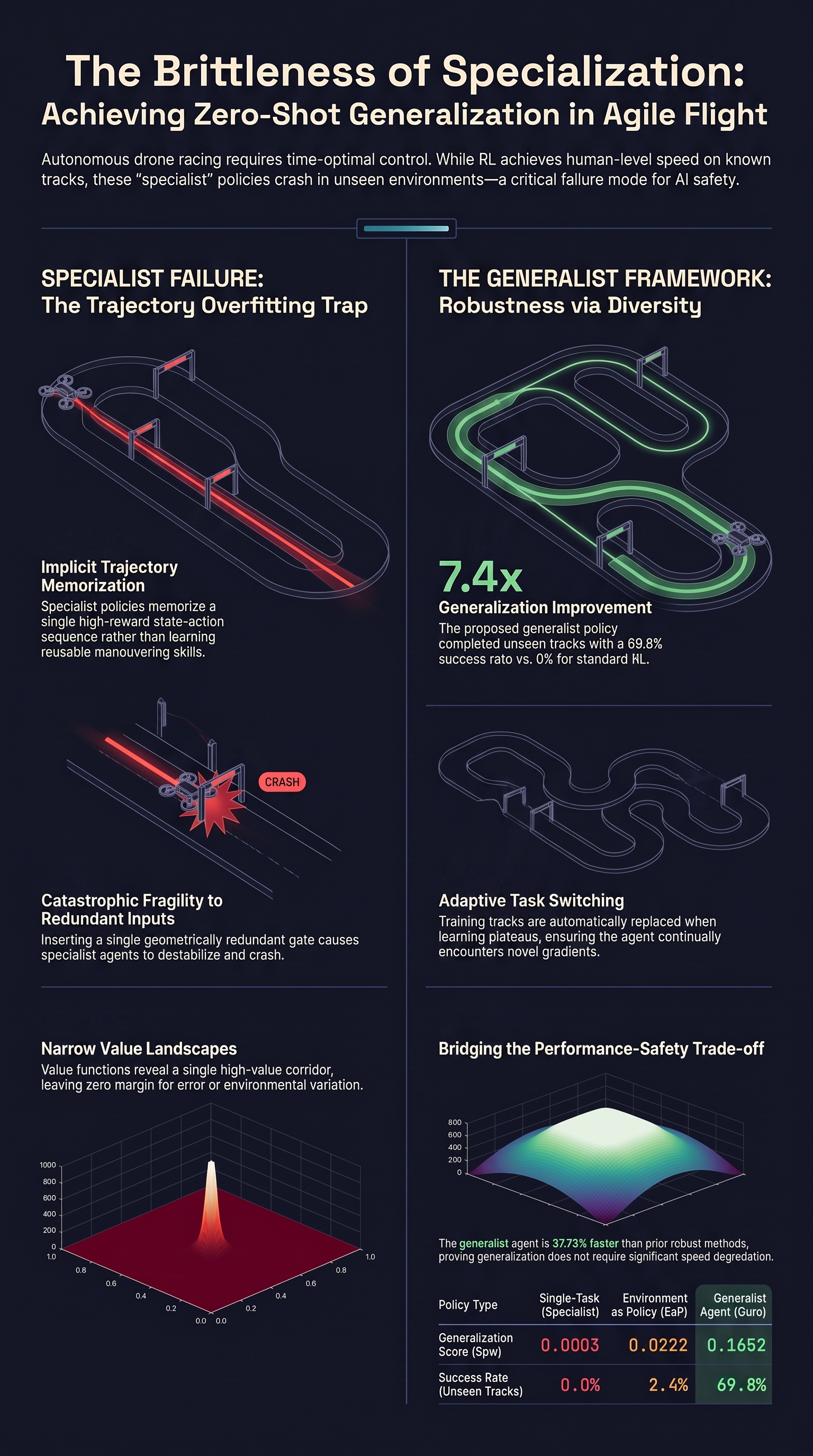
Autonomous drone racing represents one of the most demanding frontiers for embodied AI. Operating at speeds exceeding 80 km/h, these systems function under persistent actuation saturation, where the margin for error is nearly non-existent. While deep reinforcement learning (RL) has enabled agents to reach human-level performance on specific, known tracks, these controllers exhibit a documented brittleness. When placed in an unseen environment, agents that dominate a training track often fail immediately, typically crashing before completing a single lap.
This failure highlights a critical bottleneck in agile flight: the perceived trade-off between performance and robustness. Traditionally, achieving high speeds required specialized controllers that could not generalize, while more robust methods resulted in significantly slower flight. In a recent paper, Green et al. (2026) propose a framework that challenges this dichotomy, demonstrating “zero-shot generalization” (ZSG)—the ability to fly unseen tracks without additional training—while maintaining competitive racing speeds.
The Overfitting Problem: Why Specialization Leads to Failure
The authors analyzed why standard Single-Task (ST) policies, which excel on familiar tracks, fail systematically in novel settings. Their findings suggest that instead of learning reusable maneuvers or general flight principles, ST agents succumb to “implicit trajectory tracking.” The agents essentially memorize a specific sequence of observations and actions tailored to a single environment.
This failure is evidenced by the “Critic Value Maps” (Section 4, Figure 4). The authors observed that ST agents possess a “single high-value corridor,” indicating they have overfit to a rigid path. In contrast, generalist agents develop “broader high-value regions,” demonstrating the learning of adaptable maneuvers capable of recovering from perturbations. When these specialized agents are tested on unseen configurations, several distinct failure modes emerge:
- Geometric Redundancy Sensitivity: When a redundant gate is added to a known track along the existing flight path, ST agents often destabilize and crash (Figure 6A), despite the required trajectory remaining identical.
- Memorized Directional Bias: The authors noted that agents trained on the BigS track failed on the Kidney track because they attempted a right-hand turn where the new track required a left (Figure 6B).
- Catastrophic Forgetting: Sequential training on individual tracks results in the immediate collapse of performance on previous tracks once a new environment is introduced (Appendix A.8).
The Generalist Framework: Parallelism and Informed Design
To move beyond these failures, the proposed framework avoids the forgetting common in sequential training by utilizing a parallelized paradigm. The policy is updated using rollouts collected simultaneously across multiple different racetracks.
Informed Task Generation
Rather than relying on uniform random sampling of gate positions, which often produces physically impossible or uninformative tracks, the authors developed a procedural generator based on B-Splines (Algorithm 1).
“This process involves fitting a B-Spline to points in 3D space and placing gates tangent to the curve at arc-length spaced intervals. This ensures that the generated tracks are geometrically feasible and diverse, admitting at least one smooth trajectory and providing a consistent learning signal.”
The authors specify that this method approximates dynamic feasibility by enforcing curvature and spacing constraints, ensuring the tasks remain within the quadrotor’s flight envelope.
Adaptive Task Switching
To keep the agent from overfitting to any single task in the training set, the framework uses an “Adaptive Task Controller” to detect “reward flatness”—the point at which a task no longer provides a meaningful learning signal. The authors utilized two primary methods for detection:
- Spearman’s Rank Correlation: A statistical measure of the correlation between rewards and timesteps; a score near zero identifies a plateau.
- Kalman Filter: A local linear trend model used to estimate the posterior likelihood that the underlying reward trend () has a magnitude less than a specified tolerance ().
When a task is identified as saturated, it is asynchronously replaced with a new track from the generator.
Performance Metrics: Breaking the Speed-Generalization Trade-off
To capture both feasibility and performance, the authors introduced the Performance-Weighted Success Score (). It is defined mathematically as the quotient of the success rate and the fastest lap time, averaged across all evaluation tasks:
| Metric | Generalist Agent (Ours) | Environment as Policy (EaP) | Single-Task (ST) |
|---|---|---|---|
| Generalization (Max ) | 0.1652 | 0.0222 | 0.0003 |
| Success Rate (Unseen Tracks) | 69.8% | 2.4% | 0.0% |
| Flight Speed (Relative) | Baseline | 37.73% Slower | 14.52% Faster* |
| *Note: While ST agents are faster on their specific training tracks, they achieved a 0% success rate on unseen configurations. |
The generalist agent demonstrated a 7.4x improvement in generalization over state-of-the-art methods while maintaining a 37.73% speed advantage over prior robust methods like EaP.
From Pixels to Propellers: Vision-Based Generalization
The framework was extended to vision-based agents navigating via pixel inputs. The authors describe a critical Actor-Critic asymmetry in the architecture: while the Actor operates under an information bottleneck using a CNN image embedding and partial state information (rotation, velocity), the Critic receives the full state () to ensure training stability (Figure 2).
The authors characterize these results as a milestone in agile flight:
- First ZSG Success: This is the first demonstration of zero-shot generalization for vision-based, high-speed drone racing, achieved using a “gate-brightness encoding” strategy to signal gate sequence.
- Hardware Deployment: The agent completed all core tracks in the real world with a 100% success rate.
- The Sim-to-Real Gap: The measured gap was only 6.575%, representing the mean increase in lap time when moving from simulation to hardware.
Failure-First Takeaways for AI Safety Researchers
For researchers focusing on the robustness of autonomous systems, this study offers several technical insights into agent failure:
- The Insufficiency of Absolute Thresholds: Fixed reward thresholds are unreliable due to varying reward scales across tasks. Measuring the rate of improvement (flatness) via Spearman’s rank or Kalman filters is a more robust metric for task switching.
- Informed vs. Random Task Sampling: High-dimensional task spaces suffer from sparsity. Random sampling produces uninformative tasks; “informed” generation that respects the underlying physics and curvature constraints of the system is necessary for safety-critical training.
- Regularization Sensitivity: In on-policy RL, L2 regularization is highly sensitive. The authors found that a weight decay of improved generalization, but a value of destabilized training entirely.
- Implicit Memorization as a Failure Mode: Researchers should utilize “geometrically redundant” obstacles as a red-teaming strategy. If an agent crashes after clearing an obstacle that did not require a path change, it is likely relying on implicit trajectory tracking rather than a reusable maneuver policy.
Conclusion: A Roadmap for Robust Embodied AI
The work by Green et al. indicates that the trade-off between speed and generalization in agile flight is an architectural challenge rather than an immutable law. By combining parallel task training with physically informed environment generation, it is possible to create agents that are both fast and flexible.
Remaining limitations include extrapolation to dynamic gates and the requirement for partial state information in vision-based agents. However, the authors conclude that generalist pre-training provides a superior foundation for specialized deployment; fine-tuning a generalist agent for a specific track requires only ~23% of the training iterations compared to training an ST agent from scratch (relative to timesteps), while ultimately yielding superior lap times. This provides a scalable framework for deploying robust AI in unpredictable real-world environments.
Read the full paper on arXiv · PDF