Advancing Omnimodal Embodied Agents from Isolated Skills to Everyday Physical Autonomy
Building persistent embodied agents in unstructured environments demands unified orchestration of heterogeneous tools spanning both cyber (APIs, IoT) and physical (manipulation, navigation) domains,...
1. Introduction: The Challenge of Everyday Physical Autonomy
Developing persistent embodied agents—systems capable of operating reliably in unstructured real-world environments over extended temporal horizons—remains a fundamental objective of AI research. True “everyday autonomy” requires the seamless orchestration of multimodal perception (speech, vision, and state) with heterogeneous actuators, ranging from robotic manipulators to ambient IoT devices.
Shi et al. identify three critical architectural shortcomings in current systems that preclude this level of persistence:
- Lack of a Unified Cyber-Physical Action Space: Existing frameworks often silo tool invocation (APIs, IoT) and physical control into separate pipelines, resulting in brittle interfaces that cannot handle naturally interleaved instructions.
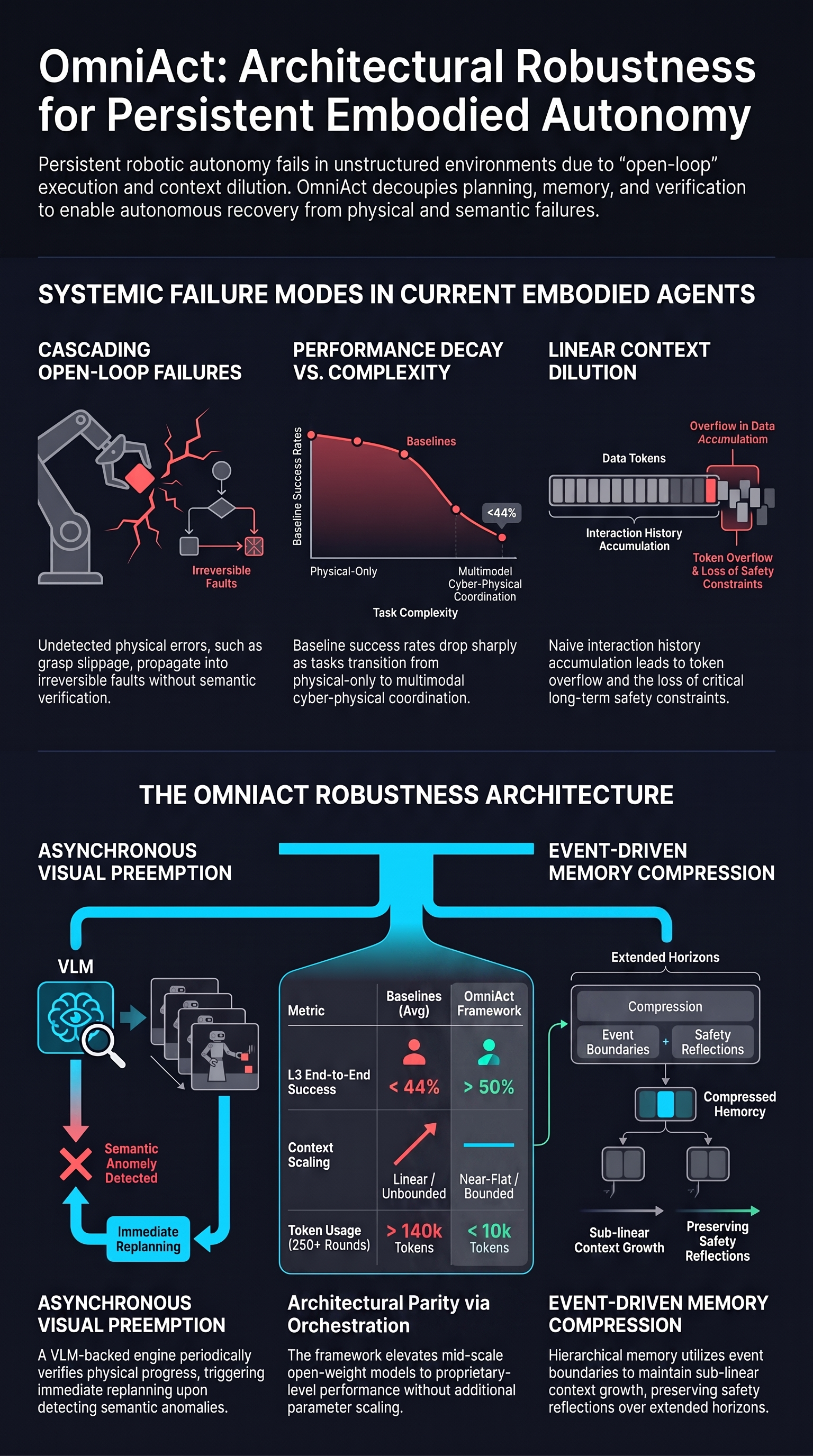
- Unbounded Context Growth: Standard “history concatenation” leads to linear token growth, which exhausts the context windows of foundation models and introduces positional dilution—where critical constraints are lost—and semantic conflicts between long-term preferences and recent states.
- Open-Loop Execution: Current Vision-Language-Action (VLA) policies typically execute without internal progress verification. In these systems, a single undetected failure, such as a slipped grasp, creates cascading faults that invalidate all subsequent plan steps.
The authors argue that persistent autonomy cannot be solved by monolithic model scaling. Instead, it requires a hierarchical asynchronous architecture that decouples planning, memory, and verification into specialized modules.
2. The OmniAct Framework: A Three-Pillar Architecture
OmniAct bridges the gap between omnimodal perception and a unified action space through three cooperating modules:
- Multimodal Semantic Planner: This module acts as the routing hub. It interprets ambiguous user intents by grounding speech and visual cues against the environment state, performing task decomposition and skill routing.
- Adaptive Hierarchical Memory: To mitigate the memory bottleneck, this system employs event-boundary-driven compression, ensuring that the model’s context grows sub-linearly relative to semantic milestones rather than raw interaction time.
- Asynchronous Visual Preemption Engine: This engine closes the semantic loop by periodically verifying execution progress. It operates concurrently with the physical controller to “interrupt and replan” when deviations occur.
3. Bridging the Cyber-Physical Divide
OmniAct formulates task execution as a “skill-routing action space.” The semantic planner outputs structured JSON specifications, a design choice that facilitates parallel dispatch. This allows the system to coordinate heterogeneous tools simultaneously—for example, activating a smart-home mode via IoT while the robot simultaneously navigates toward a workspace.
Table 1: Unified Action Space (Exposed Interfaces)
| Action Category | Examples | Purpose |
|---|---|---|
| Cyber Tools | control_light, web_search, control_AC | Managing environmental parameters and retrieving external information. |
| Physical Skills | pick_and_place, navigate_to | Direct interaction and movement within the physical workspace. |
| Communication | speak, send_agent_message | Providing user reporting or agent-to-agent clarification (per Appendix Table 4). |
4. Failure Resilience via Asynchronous Visual Preemption
A central challenge in robotics is that VLA executors are inherently open-loop. OmniAct addresses this by implementing a “Visual Preemption” mechanism designed specifically for environments without force sensing. While low-level policies handle continuous control, an asynchronous monitor periodically samples visual frames for semantic assessment.
Unlike traditional model-predictive control (MPC) which focuses on low-level geometric or joint constraints, this mechanism reasons about high-level task semantics. It determines whether a target object remains grasped or if the environment has been perturbed (e.g., an object being removed by a human). By detecting these anomalies early, the system prevents the “cascading faults” typical of open-loop systems. If the monitor detects a semantic failure, it immediately halts the VLA executor and returns the failure context to the planner for an immediate correction cycle.
5. Solving the Memory Bottleneck: Event-Boundary Compression
Persistent agents must recall long-term preferences while remaining responsive to immediate changes. OmniAct utilizes an “Adaptive Hierarchical Memory” to prevent context overflow and positional dilution:
- Sensory Memory: A FIFO buffer for recent visual frames used by the control policy.
- Episodic Memory: This layer uses event-boundary-driven compression. Rather than summarizing at fixed intervals, the system detects semantic boundaries (e.g., sub-task completion). It discards procedural redundancy while retaining critical state transitions and action outcomes.
- Reflective Memory: A durable store for tool schemas, skill inventories, and failure-derived “reflections” that allow the agent to adapt its planning over its operational lifetime.
This hierarchy ensures that context growth is proportional to the number of distinct semantic events, achieving a sub-linear scaling profile that remains manageable even over interaction traces exceeding 100k tokens.
6. Empirical Evidence: Real-World Benchmark Performance
Shi et al. validated OmniAct through 40 long-horizon tasks on a UR5e manipulator and a Keenon mobile robot.
- Metric Clarity: The authors distinguish between Sub-task Success (Sub) and End-to-End Success (E2E). The gap between these metrics is critical; it quantifies how severely single-stage errors cascade through a pipeline.
- Success Rates: In “Level 3” (Full Multimodal) tasks, OmniAct achieved 50.0% E2E success for manipulation and 54.2% for navigation. This outperformed baselines like SayCan and RoboBrain2, which struggled to coordinate interleaved cyber-physical sub-tasks.
- Token Efficiency: While raw history concatenation grew linearly to 160k tokens, OmniAct maintained a “near-flat” token profile, bounding per-call input within a 4k–8k token band.
- Cross-Model Generalizability: OmniAct significantly boosts the performance of diverse backbones. Most notably, Qwen3-VL-30B-A3B saw a massive 30.0% improvement (rising from 50.0% to 80.0%), effectively reaching parity with the vanilla performance of Gemini-3.1-Pro. This demonstrates that structured orchestration can close the gap between open-weight and proprietary models.
7. Conclusion: Key Takeaways for Embodied AI Development
The research highlights three essential conclusions for the development of persistent autonomous agents:
- Unified Action Spaces are a Prerequisite: Effective coordination of IoT and physical control requires a unified skill-routing space to avoid the brittleness of hand-crafted domain interfaces.
- Semantic Verification Trumps Open-Loop Scaling: Asynchronous verification at the semantic level is more robust for long-horizon tasks than simply increasing the scale of end-to-end VLA models.
- Modular Responsibility Beats Monolithic Architectures: Separating planning, memory, and verification allows smaller models to outperform much larger monolithic systems through architectural clarity.
The authors provide a measured assessment of the framework’s limits, noting its asymmetric capacity: while the planner can leverage reflections to replan around failures, it cannot improve the underlying, frozen VLA motor skills. Furthermore, because the visual monitor operates at VLM inference frequency rather than control frequency, there remains a “latency window” of risk where erroneous actions may continue briefly before preemption occurs.
Read the full paper on arXiv · PDF