NavIsaacLab: Generating Realistic Crowd via Parallel Robot Learning for Benchmarking Human-aware Navigation
Robot autonomous navigation that accounts for surrounding human activities is crucial for ensuring both safety and natural human-robot interaction in real-world environments shared by humans and...
Introduction: The Challenge of the “Social” Robot
Developing robots capable of operating in human-centric environments requires a paradigm shift from simple obstacle avoidance to “human-aware” navigation. As identified by Xia et al., the core research problem lies in the requirement that robots prioritize human comfort and social norms alongside path efficiency. Traditional navigation stacks often falter in dense crowds because they treat humans as mere dynamic obstacles rather than intentional agents whose movements are governed by complex social expectations.
The authors highlight three primary limitations in current simulation benchmarks that impede the development of robust, deployable policies:
- Low Physical Fidelity: Many existing simulators utilize simplified 2D representations or kinematic approximations that fail to capture 3D physical dynamics.
- Simplistic Pedestrian Modeling: Benchmarks frequently rely on “2D dots” or handcrafted rule-based models (e.g., Social Force Models) that lack the nuance of human motion.
- Computational Bottlenecks: A lack of parallelization limits the data throughput necessary for Reinforcement Learning (RL), preventing the systematic exploration of complex interaction edge cases.
NavIsaacLab is introduced as a framework designed to bridge the “reality gap” through high-fidelity, GPU-parallelized training, providing a foundation for policies that translate more reliably to real-world deployment.
Architecture: Leveraging NVIDIA Isaac Lab for Scalability
The technical foundation of the platform is built upon NVIDIA Isaac Lab, which facilitates GPU-based parallel simulation. This architecture enables the framework to synchronize thousands of simultaneous robot and environment instances, providing the high data throughput required for sample-intensive RL.
The “Scene Construction” module utilizes Universal Scene Description (USD) formatted assets to build 3D environments. Xia et al. curated 30 artist-crafted scenes from the OmniGibson dataset, ranging from domestic homes to large public stations. Within the Isaac Lab Scene Graph, every asset has explicitly defined mesh geometry and material textures, ensuring that the physical interactions and photorealistic rendering are grounded in consistent physical properties rather than visual proxies.
The Human Element: From “2D Dots” to Physics-Based Agents
Xia et al. contrast their data-driven approach with the handcrafted rules typical of simulators like ORCA or Social Force Models (SFM). In NavIsaacLab, pedestrians are treated as articulated, physics-based agents rather than scripted animations.
The Pedestrian Generation module is structured as follows:
- Kinematic Foundation: Pedestrians are modeled using the Skinned Multi-Person Linear (SMPL) model, featuring 24 actuated joints (including the pelvis, hips, and neck) to replicate natural human kinematics.
- Visual Fidelity: A skinned mesh provides the surface geometry for photorealistic RGB-D rendering. This allows the robot’s vision system to perceive body orientation and posture, which are critical cues for intent inference.
Comparison of Simulation Benchmarks
| Attribute | Kinematic-based (e.g., SocNavBench, SEAN) | NavIsaacLab |
|---|---|---|
| Pedestrian Modeling | Kinematics / 2D Trajectories | Physics-based Dynamics (Joint-controlled) |
| Behavior Authoring | Handcrafted Rules (SFM/ORCA) | Data-driven (Trace and Pace Frameworks) |
| Visual Fidelity | 2D Geometry or Scripted Animation | Photorealistic 3D SMPL Models |
| Sensor Feedback | Perfect observation / 2D proxies | Photorealistic 3D RGB-D |
| Parallelization | Limited or None | GPU-accelerated Parallel Simulation |
The Methodology: Trajectory Diffusion and Adversarial Motion Priors (AMP)
To achieve realistic crowd dynamics, Xia et al. implement a hierarchical control system grounded in the Trace and Pace frameworks. This system replaces rigid animations with responsive, joint-level movements.
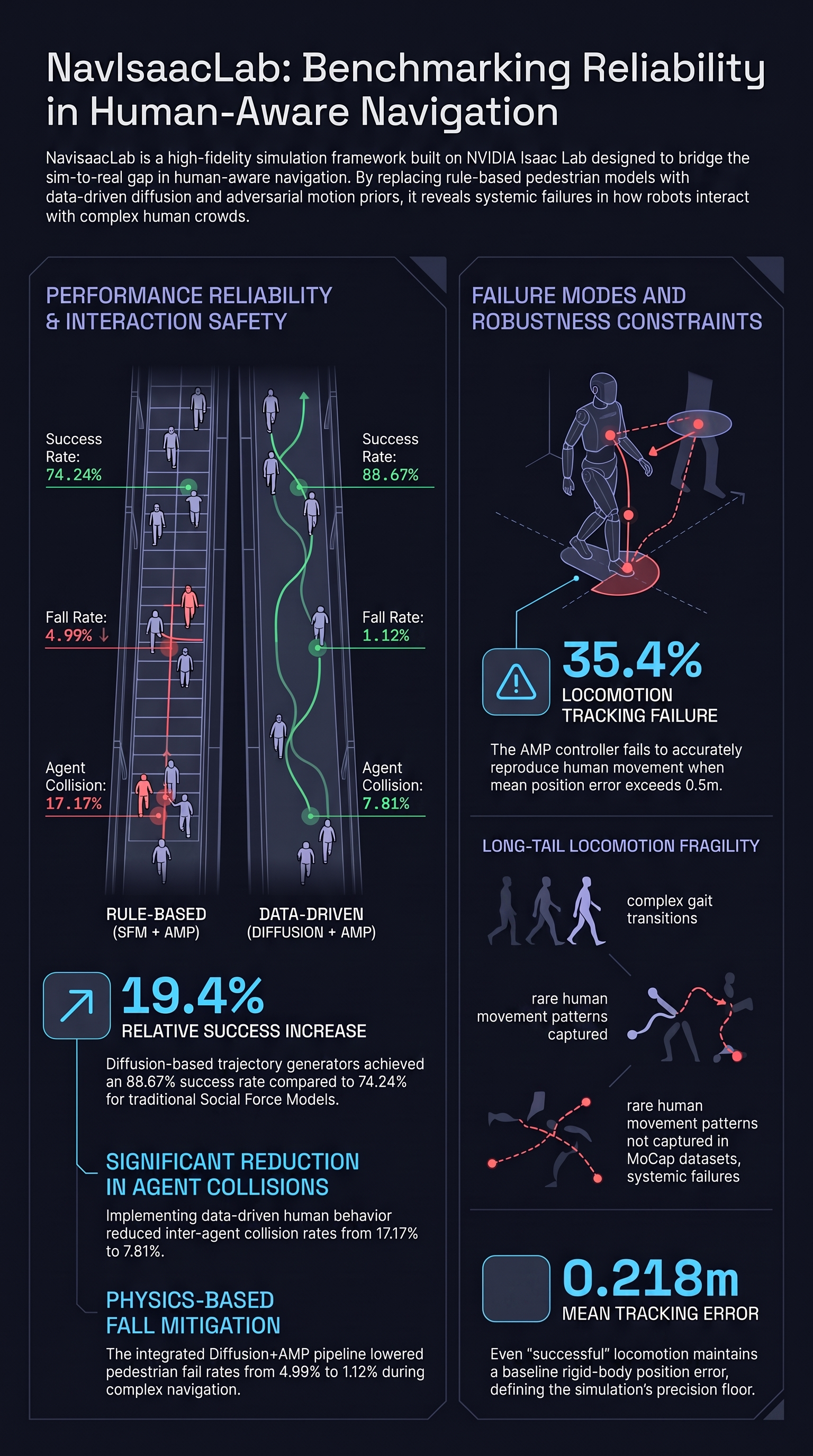
- Local Trajectory Generation: The authors utilize a trajectory diffusion model (U-Net architecture) to denoise paths into collision-free routes. This model generates a future trajectory segment over a 5-second horizon, conditioned on the agent’s past motion, neighboring agent trajectories, and environmental occupancy maps.
- Whole-Body Control: These trajectories are mapped to joint-level movements via Adversarial Motion Priors (AMP) and imitation learning. The pedestrian policy network is trained to maximize a reward function that balances realism with goal completion: . This ensures the agent tracks the target trajectory while matching real-world human motion data (MoCap).
Benchmarking for Robustness and Safety
The platform includes a standardized Benchmarking Suite that evaluates policies using multi-dimensional metrics such as proxemics, human-human interaction contexts, and adherence to social norms. To ground these experiments, the authors utilize the Nova Carter differential-drive mobile base as the primary robot platform.
NavIsaacLab supports testing across various scenarios to identify failure modes, including narrow doorways, bidirectional crossings, and obstructions. A significant technical contribution by Xia et al. is the demonstration of vision-based RL policies that utilize a Transformer encoder for posture-corrected attention. This allows the robot to infer human intention from body orientation, anticipating future paths more accurately than is possible through position-based tracking alone.
Failure-First Implications for AI Safety Researchers
For researchers focused on AI safety and red-teaming, NavIsaacLab offers a high-fidelity sandbox for identifying systematic failures in embodied AI:
- Sim-to-Real Reliability: The high-fidelity physics engine reduces the “reality gap” by ensuring policies are not overfitted to simulation artifacts.
- Mitigating Social Discomfort: Standard benchmarks often suffer from “discontinuities”—abrupt changes in gait or posture in scripted agents—that cause robot navigation stacks to miscalculate. NavIsaacLab’s joint-level consistency ensures fluid motion, allowing researchers to study how robots prevent “social failures” (e.g., violating personal space or causing human discomfort).
- Systematic Evaluation of Intent Inference: By providing realistic visual cues like gaze and orientation, the platform allows for the rigorous testing of how well a robot can perceive implicit signals to prevent collisions in high-density crowd scenarios.
Conclusion and Key Takeaways
Xia et al. have developed NavIsaacLab to provide a scalable, high-fidelity alternative to traditional navigation benchmarks. By integrating physics-based human modeling with GPU-parallelized training, the framework offers a robust environment for developing safety-critical navigation policies.
Key Takeaways for Practitioners:
- Scalability via GPU Parallelization: Massive parallelism is required to achieve the sample throughput necessary for training RL policies capable of generalizing across diverse human-populated scenes.
- Data-Driven Human Realism: Moving from rule-based models to the Trace and Pace approach (Diffusion + AMP) is essential for capturing the stochasticity and nuances of real human interaction.
- Importance of Joint-Level Control: Physics-based, joint-level control prevents the motion discontinuities that lead to navigation stack failures, providing a more reliable foundation for sim-to-real transfer.
- Implicit Cues and Intent: Safety researchers should prioritize “posture-corrected” perception; utilizing cues like body orientation via Transformer-based encoders significantly improves proactive avoidance and social compliance.
Read the full paper on arXiv · PDF