Toward Low-Latency Vision-Language Models with Doubly-Correct Predictions in Egocentric Visual Understanding
The rapid rise of Vision-Language Models (VLMs) in egocentric visual understanding has made low-latency inference in human-robot collaborative (HRC) tasks increasingly critical.
1. Introduction: The Latency-Safety Paradox in Robotics
The rapid integration of Vision-Language Models (VLMs) has transformed egocentric visual understanding, providing robots with the human-centric perception required for complex interactions. However, deploying these massive architectures in human-robot collaborative (HRC) tasks introduces a severe latency-safety paradox. In systems like quadruped robots, real-time constraints are absolute; onboard hardware must process high-frequency semantic data to facilitate closed-loop control and prevent collisions.
To bridge the gap between high-capacity VLMs and the resource constraints of embodied hardware, researchers typically employ weight pruning. While effective at reducing computational overhead, standard pruning prioritizes top-line accuracy, often at the expense of “doubly-correct” predictions—where the model is not only accurate in its label but grounded in valid visual evidence. This report details the findings of Wang et al., who investigated the impact of model compression on VLM reliability and proposed a rationale-informed pruning strategy to safeguard grounded decision-making in safety-critical robotics.
2. The “Doubly-Correct” Framework: More Than Just Accuracy
Wang et al. define a Doubly-Correct Prediction (DCP) as one where the output is both factually accurate and supported by valid visual evidence. This framework is grounded in “Sufficient Input Subsets” (SIS) theory, which identifies the minimal input required to preserve a prediction. In egocentric contexts, the authors define the human-manipulated object as the primary rationale for any given action.
The Three Pillars of Egocentric Rationale
- Spatial Rationale: Localizing the position of the manipulated object within a frame (the “where”).
- Temporal Rationale: Identifying the specific frames in a video sequence where the action-relevant object is present (the “when”).
- Prediction Correctness: Achieving the correct high-level action label, typically a verb-noun pair (e.g., “first-aid-CPR”).
Reliability Metrics
To quantify these pillars, the authors utilize a specific evaluation protocol. For spatial grounding, they employ Relevant Mass Accuracy (RMA). Recognizing that AI safety requires prioritizing the detection of all relevant objects, they introduce a weighted variant, RMAf, using a factor of . This weights recall more heavily than precision, as a false negative (missing a critical object) in a task like teleoperated grasping is far more dangerous than a false positive (including background noise).
Decisions are then categorized across three comprehensive metrics:
- Prediction Trustworthiness (PT): The proportion of valid rationales among correct predictions.
- Inference Reliability (IR): The proportion of correct predictions among valid rationales.
- Right-Right (RR) Samples: The total proportion of samples that are both accurate and correctly grounded.
3. The Hidden Risks of Standard Pruning Methods
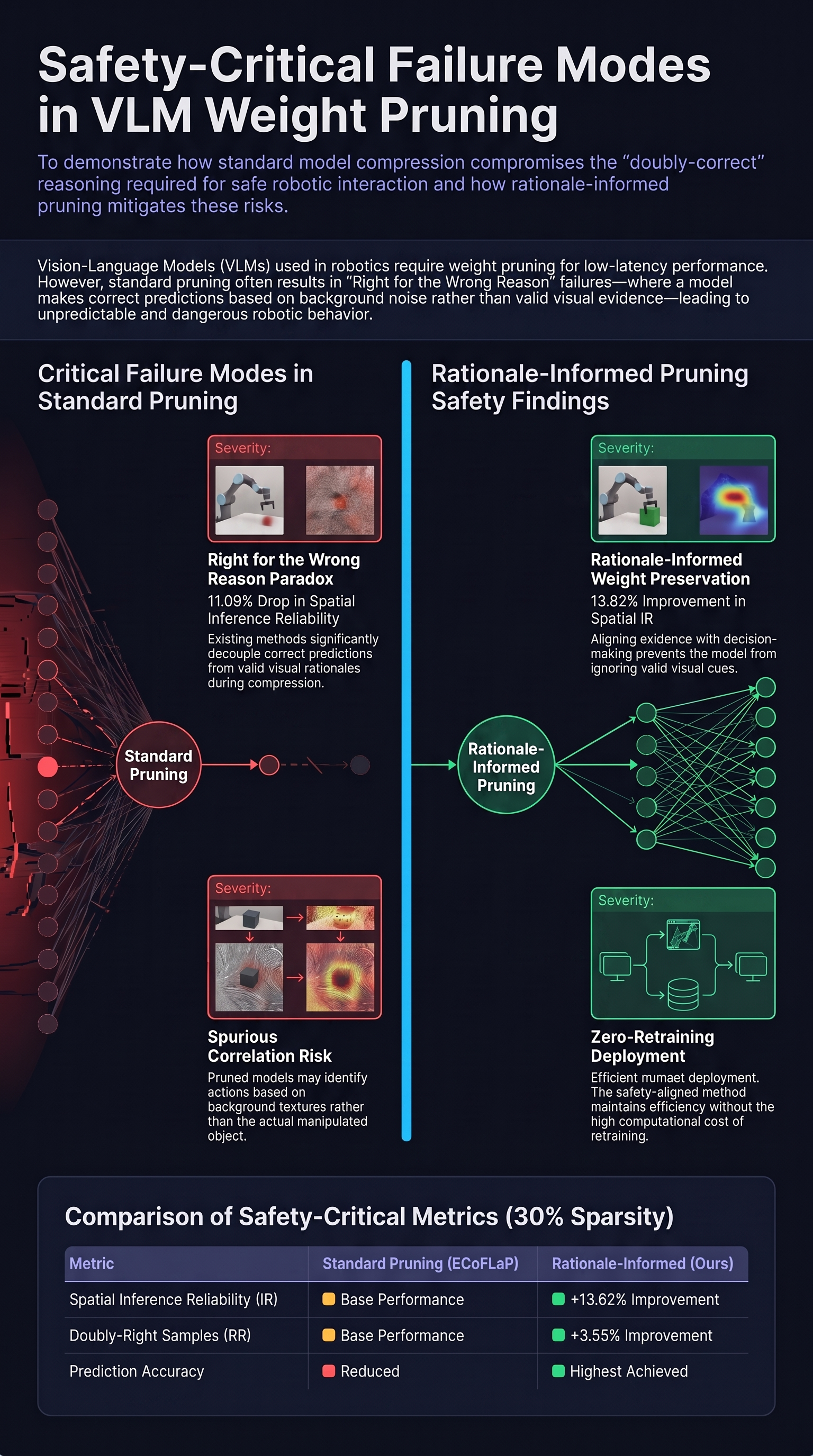
Wang et al. conducted a diagnostic study on four post-training pruning methods: One-Shot Magnitude Pruning (OMP), Global Magnitude Pruning (GMP), Kwon et al., and ECoFLaP. Their findings reveal a latent failure mode that evades standard accuracy benchmarks: the “Right for the Wrong Reason” scenario. Here, a model predicts a label correctly but bases its decision on spurious correlations, such as background textures, rather than the target object.
Crucially, the study identifies a “Wrong Prediction/Right Rationale” (WR) state. Pruning often preserves the model’s ability to localize evidence but destroys its ability to use that evidence to reach the correct conclusion. In the EPIC-KITCHENS VISOR dataset, standard methods like ECoFLaP saw Inference Reliability (IR) drop by as much as 11.09%, even when accuracy remained relatively stable.
Table 1: Latent Failure Modes in Pruned VLMs (EPIC-KITCHENS VISOR)
| Metric | Definition | Observed Effect in Standard Pruning | Resulting Safety Risk |
|---|---|---|---|
| Prediction Trustworthiness (PT) | Proportion of valid rationales when predictions are correct. | Often stable; may show superficial improvement. | False Confidence: The model appears grounded only when it happens to be right. |
| Inference Reliability (IR) | Proportion of correct predictions when rationales are valid. | Significant degradation (e.g., 11.09% drop). | WR Failure: The model identifies the right object but performs the wrong action. |
4. Technical Deep Dive: Rationale-Informed Pruning
The authors’ proposed solution addresses the primary computational bottleneck: the Vision Encoder. According to the paper’s GFLOPs analysis, the vision encoder is approximately 37 times more computationally expensive than the multimodal fusion module. By targeting this component with a rationale-informed strategy, the authors aim to prevent the removal of “memory units” in the Transformer feedforward layers (FFN) that connect visual evidence to final classification logits.
Methodology and Hessian Modulation
The strategy follows a two-step methodology:
- Layer-wise Allocation: Instead of a uniform ratio, the authors assign non-uniform pruning ratios () based on weight magnitudes ( norm) within each layer, acknowledging that different depths contribute unequally to semantic understanding.
- Hessian Modulation: The authors utilize the Hessian matrix, which represents the local curvature of the loss function, to estimate weight importance. To protect critical semantic pathways, they modulate the Hessian using a refined rationale mask ().
This mask is a convex combination of the model’s internal rationale heatmap () and an all-ones baseline matrix (), governed by a semantic factor (): The factor is determined by the cosine similarity between the explanation object and the predicted class. This ensures that when a localized object is highly relevant to a class, the curvature of the loss function is constrained to prevent the pruning of weights essential for transmitting that specific evidence.
5. Benchmarking Performance: VISOR and EgoExo4D Results
The proposed method was benchmarked across the EPIC-KITCHENS VISOR and EgoExo4D datasets using ActionCLIP, CLIP ViT-B/16, and ViT-B/32 backbones. The results demonstrate that preserving the link between rationale and prediction actually improves overall accuracy.
- Prediction Superiority: The method consistently outperformed ECoFLaP and Kwon et al. in top-1 accuracy across various pruning ratios.
- Enhanced Reliability: On the VISOR dataset at a 30% pruning ratio, the authors’ method improved Spatial IR by 13.62% and Spatial RR by 3.65% compared to ECoFLaP.
- Cross-Backbone Stability: Performance gains remained consistent across different VLM architectures, proving the method’s generalizability.
- Strategic Neuron Retention: Visualization of the vision encoder revealed that this method preserves a higher proportion of neurons in layers 6 and 9. The authors posit these mid-to-late layers are critical for maintaining deeper semantic representations and aligning rationales with decisions.
6. Practical Implications for AI Safety and Deployment
From a “Failure-First” perspective, this research highlights that accuracy is a deceptive metric if it is decoupled from grounding. In physical robotic deployment, such as teleoperated grasping, the visual rationale is the primary interface for human trust. If a robot correctly identifies a tool but its internal logic is based on the table texture, the system remains a “black box” prone to sudden, catastrophic failure during minor environmental shifts.
By mitigating “Right for the Wrong Reason” failures, Wang et al. provide a framework for creating auditable, compressed models. This approach ensures that when a robot acts, it does so because it has correctly processed the relevant environmental cues, reducing the risk of human injury and system breakdown.
7. Conclusion and Key Takeaways
Wang et al. demonstrate that standard model compression can silently undermine the safety of Vision-Language Models. By utilizing a model’s own internal heatmaps and semantic similarity to guide weight removal, it is possible to achieve low-latency inference without sacrificing the groundedness of the model’s decisions.
Key Takeaways:
- Efficiency and safety are coupled: Model pruning choices directly impact the link between evidence and action; optimizing for FLOPs alone invites latent failure modes.
- Standard benchmarks are insufficient: Reliability metrics (IR and RR) are essential to identify models that are “Right for the Wrong Reasons.”
- Rationale-informed constraints protect logic: Using Hessian modulation to safeguard “memory units” in mid-to-late layers ensures that visual rationales are successfully propagated to the final prediction.
Read the full paper on arXiv · PDF