Decentralized Pose Graph Riemannian Optimization for Object-based Multi-Robot SLAM
Pose graph optimization (PGO) is a key back-end component for state estimation in networked multi-robot simultaneous localization and mapping (SLAM).
1. Introduction: The High Stakes of Multi-Robot Coordination
In safety-critical environments—such as subterranean exploration, search-and-rescue operations, and large-scale industrial inspections—the success of an autonomous mission depends on precise state estimation. Simultaneous Localization and Mapping (SLAM) is the foundational technology that allows robots to navigate these spaces. However, as robot swarms grow in size, the “back-end” process known as Pose Graph Optimization (PGO) often becomes a critical point of failure.
In their paper, “Decentralized Pose Graph Riemannian Optimization for Object-based Multi-Robot SLAM,” Zhao et al. (2026) address a fundamental vulnerability in modern robotics: the reliance on centralized processors. When a system depends on a single node to aggregate all data, it creates a communication bottleneck and a single point of failure. The authors’ core mission is to develop a framework that allows robots to optimize their collective maps and trajectories locally, even when communication is sparse, intermittent, or does not match the physical proximity of the robots.
2. The Problem: When Communication and Physical Reality Mismatch
Pose Graph Optimization (PGO) is the mathematical process of fusing relative measurements (like odometry or sensor readings) to create a globally consistent map. While centralized PGO is well-established, it struggles with scalability. If a central server fails or if robots move out of range, the entire coordination effort can collapse.
The authors critique current decentralized solutions for their lack of flexibility, specifically noting that existing methods often assume the “communication graph” (who can talk to whom) perfectly mirrors the “physical interaction topology” (who can see whom). In realistic deployments, this mismatch is common; for example, two robots might observe the same object but be unable to communicate directly due to signal interference.
Zhao et al. identify three primary requirements for an effective object-based PGO solver:
- Structure-Aware Communication Reduction: The system must avoid sharing redundant data, such as high-dimensional trajectories, when only a few key points are needed.
- Geometry-Preserving Optimization: It must maintain the mathematical integrity of the manifold to avoid errors in rotation and translation.
- Robustness Under Constraints: It must function reliably across time-varying and sparse network topologies.
3. The DRAN Framework: A Hybrid Decoupling Strategy
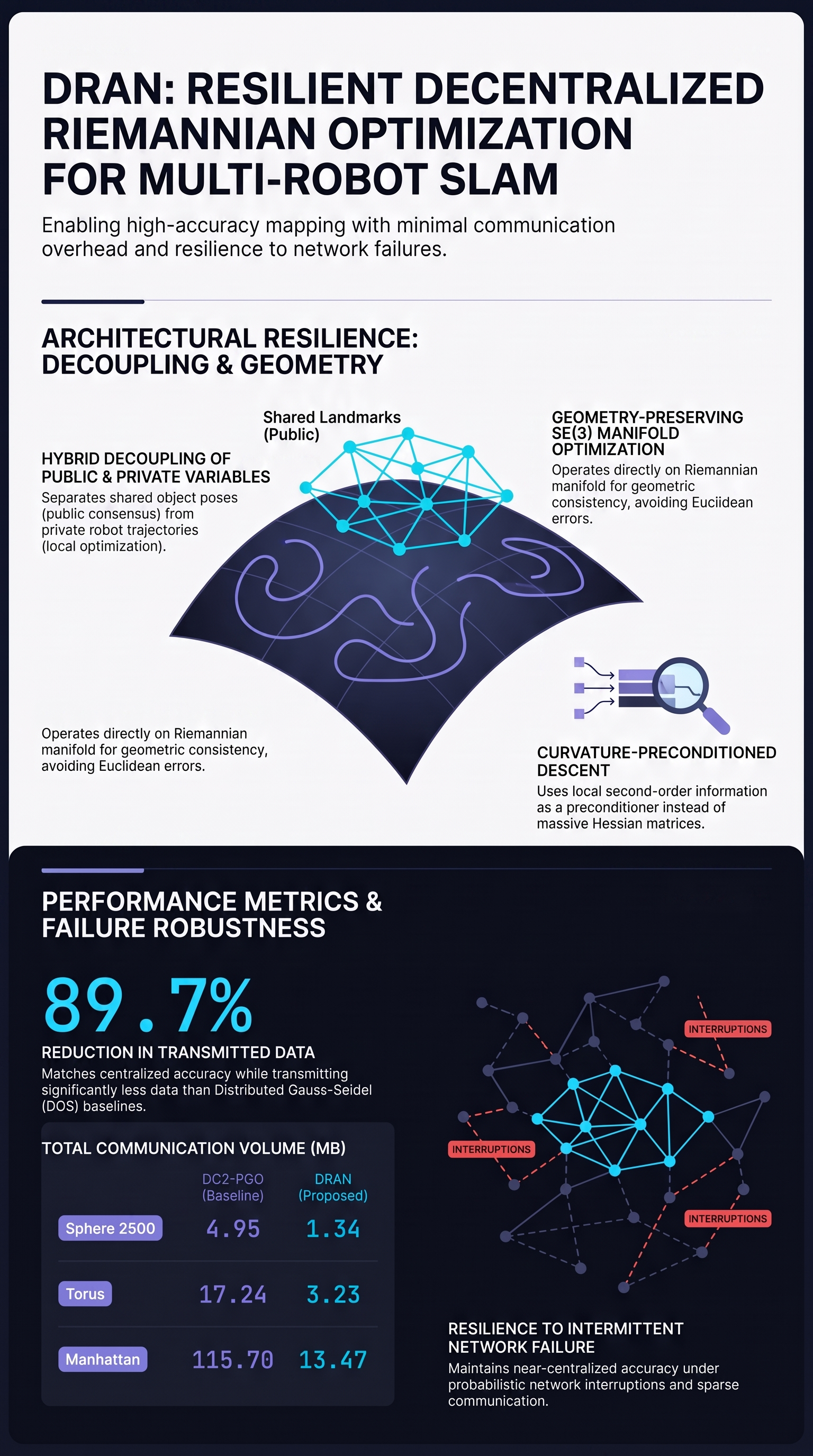
The authors introduce DRAN (Decentralized Riemannian Approximate Newton), a framework built on the “Central Insight” that shared objects and robot trajectories induce fundamentally different communication requirements. By distinguishing between “public” landmarks and “private” paths, DRAN significantly reduces the data load on the network.
Hybrid Decoupling Structure
| Variable Category | Component | Decoupling Logic | Communication Requirement |
|---|---|---|---|
| Shared Objects | Public Variables | Vertex-based | Global consensus required to ensure all robots see the “same” map. |
| Robot Trajectories | Private Variables | Edge-based | Only “separators” (key boundary poses) are shared with immediate neighbors. |
DRAN utilizes a consensus mechanism to synchronize object poses across the fleet. To achieve this, the framework employs a Metropolis-Hastings weight matrix to robustly balance information fusion and measures consistency error based on the Fréchet Mean. Instead of transmitting a robot’s entire path, DRAN identifies “separators”—the specific poses involved in inter-robot measurements. Neighbors treat these separators as fixed anchors, allowing robots to act as information relays. This allows map estimates to propagate across the network within rounds, where represents the network diameter, ensuring global consistency without the bandwidth heavy-lifting of sharing full trajectories.
4. The Mathematics of Robustness: Manifolds and Second-Order Info
A major contribution of the DRAN framework is its operation directly on the Riemannian manifold. While many systems use Euclidean approximations, Zhao et al. argue that operating on the manifold is superior because it preserves the nonlinear geometric properties of 3D space, preventing “zig-zagging” and ensuring geometric consistency.
Before optimization, the authors implement a Two-Stage Distributed Initialization to ensure stability. This involves a rotation synchronization phase solved as a linear least-squares problem, followed by a translation solving phase via a distributed Gauss-Seidel method. Once initialized, the framework utilizes an Approximate Newton scheme. The paper justifies this choice through three primary benefits:
- Improved convergence: It reaches stable solutions faster under limited communication budgets.
- Exploitation of local second-order information: It utilizes curvature data to navigate complex optimization landscapes.
- Curvature preconditioning: This allows the system to outperform standard first-order gradient descent, which often struggles with the ill-conditioned constraints of multi-robot SLAM.
To further enhance performance, the authors employ the Schur complement method. As a mathematical strategy, this allows for the efficient inversion of the Hessian matrix by decoupling private and public variables. The authors claim this technique resulted in a 41% reduction in average computation time during testing.
5. Evidence of Resilience: Benchmarks and Real-World Stress Tests
The authors validated DRAN through a rigorous three-tiered evaluation methodology:
- G2O Benchmarks: Testing on standard datasets including Parking Garage, Sphere 2500, and Torus showed that DRAN achieves near-centralized accuracy. The paper highlights a 87.62% reduction in total transmitted data compared to DC2-PGO and a 89.70% reduction compared to DGS.
- Large-Scale UAV Simulations: The authors simulated 21 UAVs navigating through 60 obstacles. Success was measured using SR-ATE (Success Ratio of Absolute Trajectory Error), SR-cost, CE (Consistency Error), and Bias. The data showed that robots’ estimates of shared objects converged rapidly to the ground truth, remaining resilient even as measurement noise ( and ) increased and communication density () decreased.
- Real-World Experiments: Validation was conducted at Zhejiang University using six Dingo robots. These robots identified objects using AprilTags and navigated circular trajectories. The results, verified against an OptiTrack ground-truth system, confirmed that DRAN maintains high accuracy and consensus even in physical environments with rate-limited communication (2 Hz).
6. Key Takeaways for Practitioners
For architects deploying autonomous swarms in unpredictable environments, the DRAN framework offers several critical lessons in system design:
- Decoupling is Efficiency: Separating persistent landmarks (public) from transient trajectories (private) is the key to bandwidth-lean SLAM.
- Geometric Integrity Matters: Manifold-based optimization prevents the “zig-zagging” and ill-conditioning common in first-order methods.
- Topology Flexibility: Decentralized systems must be able to propagate map data across the network even when the communication graph is sparse or time-varying.
The success of these findings is attributed to the DRAN framework’s ability to maintain “near-centralized accuracy” with drastically reduced overhead.
Read the full paper on arXiv · PDF