HoloAgent-0: A Unified Embodied Agent Framework with 3D Spatial Memory
LLM agents follow a practical execution loop in digital environments: they reason over structured states, invoke tools, inspect feedback, and revise actions.
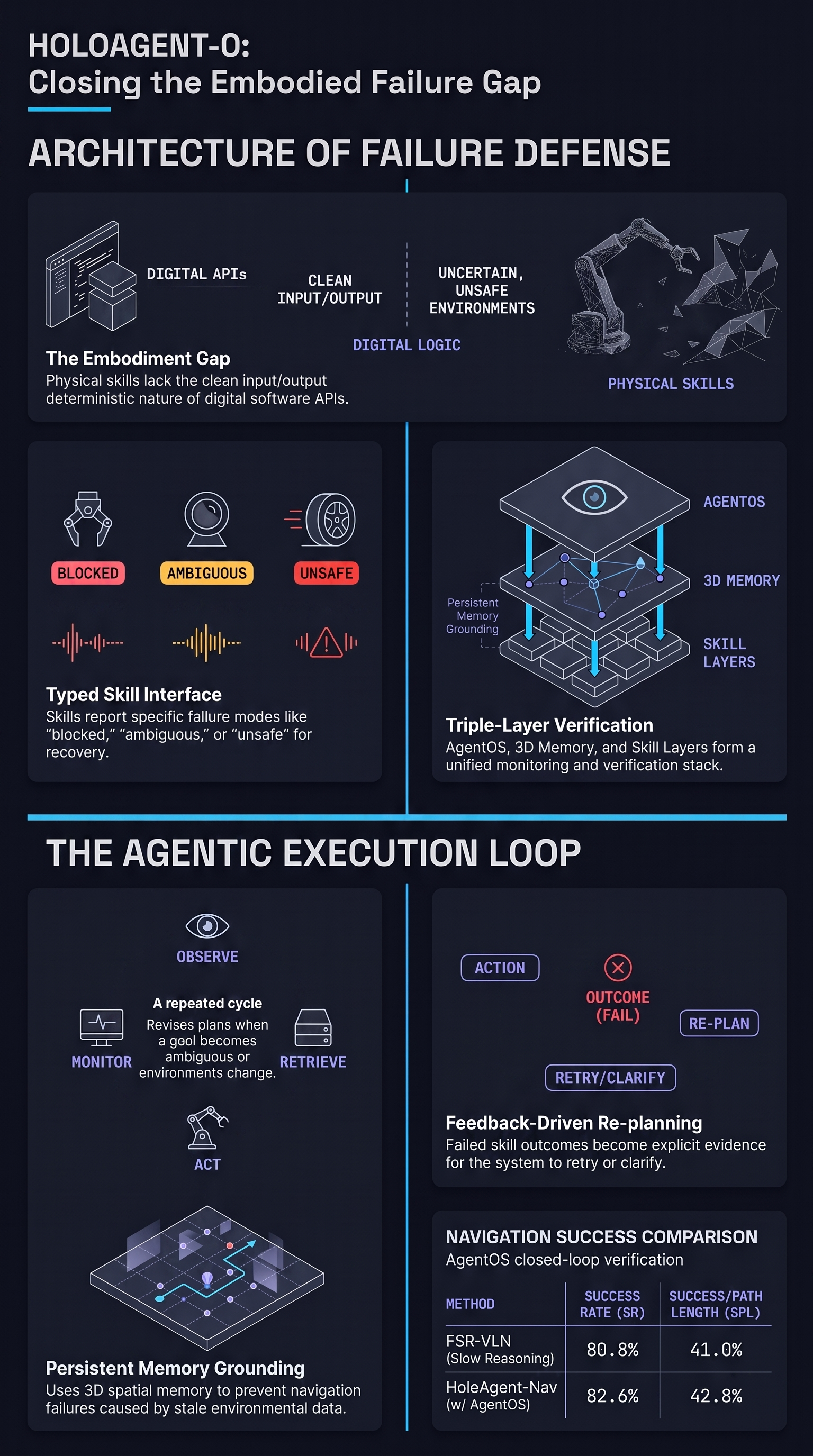
1. The API Trap: Why LLMs Break When They Touch the Floor
For the last two years, the AI community has lived in a digital gold rush. Large Language Model (LLM) agents are performing miracles in software environments—writing code, debugging workflows, and navigating deterministic APIs with surgical precision. But as any robotics engineer will tell you, the transition from silicon to steel is where the “magic” usually dies. This is the embodiment gap, a crisis of intelligence that arises because the physical world does not behave like a clean software API.
Physical execution is a messy reality of non-deterministic outputs, continuous state changes, and, most crucially, irreversible side effects. In code, you can undo a deletion; in the real world, if a robot knocks over a vase or navigates to the wrong floor because its spatial memory is stale, there is no “Ctrl+Z.” Current AI agents often fail here because they rely on “one-shot” planning—tossing a single text-based instruction to a robot and hoping for the best.
To bridge this gap, Horizon Robotics has unveiled HoloAgent-0, a unified framework that moves beyond static planning. By organizing robot capabilities into a closed-loop runtime, HoloAgent-0 allows Physical AI to reason, verify, and re-plan in real-time, treating the physical world not as a text prompt, but as a dynamic environment requiring constant observation and recovery.
2. The Blueprint: A Four-Layered Architecture for Physical Intelligence
HoloAgent-0 isn’t just a better model; it’s a system-level solution. The architecture connects high-level cloud reasoning with on-device ROS2 execution buses to create a unified intelligence loop. While the core foundation rests on three layers, the framework introduces a critical fourth functional layer—the “watchman”—to ensure reliability. The architecture includes:
- Embodied AgentOS Layer: The system runtime that converts natural language into “executable skill graphs” rather than simple text strings.
- Memory Layer: A persistent grounding system that tracks both the 3D world and the robot’s own history.
- Skill Layer: The hardware-agnostic interface that exposes physical capabilities as “Typed Skill Calls.”
- Monitoring & Verification Layer: The crucial validation engine that converts raw sensor evidence into re-planning triggers, verifying if a skill actually achieved its intended state.
3. AgentOS: The Brain that Re-plans
At the center of this innovation is Embodied AgentOS. Its core philosophy is “Closed-loop first,” meaning it treats every instruction as a repeated cycle of observe–retrieve–act–monitor. Unlike standard agents, AgentOS produces an executable skill graph. This graph isn’t just a list of steps; it includes explicit preconditions and recovery dependencies. If a robot is told to “pick up the mug,” AgentOS first verifies the precondition: Is the mug within reach? If the verification fails, the graph triggers a recovery branch to navigate closer before attempting the grasp.
The AgentOS design follows four strict principles:
- Closed-loop first: Planning is a continuous cycle, allowing for mid-action revisions.
- Memory-centric: Every plan is grounded in persistent context retrieved from the memory layer.
- Typed skill interface: Capabilities are exposed via a ROS2 command/status bus, providing the structured feedback needed for recovery.
- Observable by default: Every retrieval, state transition, and skill outcome is logged and visualized to allow the AI (and developers) to see why a plan succeeded or failed.
4. Persistent Memory: Pruning the Physical Search Space
A robot operating in a multi-room apartment cannot afford to perform an exhaustive search of every geometric point every time it moves. HoloAgent-0 solves this through a dual-memory system:
Spatial Memory & HMSG The framework utilizes a Hierarchical Multimodal Scene Graph (HMSG), which organizes the world into a hierarchy of Floors, Rooms, Views, and Objects. To avoid compute-heavy searches, the system uses “fast matching” over SigLIP descriptors. By using a Hadamard product for feature fusion (combining global context, segment appearance, and local detail), the agent can prune the search space to a specific room or view before engaging in “slow” visual reasoning. This map is incrementally updated as the robot discovers new objects or environment changes.
Temporal Memory This acts as the agent’s “Experience Summary.” It records active goals, plan states, and execution and recovery traces. If a robot fails to open a door three times, temporal memory ensures it doesn’t try a fourth identical attempt, but instead summarizes the failure and triggers a “re-plan” to find an alternative route.
5. The Skill Layer: Standardizing the Body
HoloAgent-0 separates high-level task reasoning from low-level joint control through Typed Skill Calls. This allows the same AgentOS to control a Unitree G1 humanoid just as easily as a wheeled mobile manipulator. The framework organizes robot capabilities into specialized backends:
| Backend | Skill Family | Primary Function |
|---|---|---|
| HoloNavi | Navigation | Uses a fast-to-slow reasoning loop; hierarchical object search followed by VLM-based view refinement. |
| HoloBrain | Manipulation | End-to-end VLA policy inference; outputs arm/gripper actions for dexterous pick-and-place. |
| HoloMotion | Whole-Body Motion | Supports motion-tracking (humanoid gestures) and velocity-tracking (stable walking/locomotion). |
6. Real-World Deployment: From Laundry to Shared Memory
In physical deployments on Unitree G1 and R1 hardware, HoloAgent-0 demonstrated more than just individual skills—it showed Cross-Robot Coordination. Through a “Shared Memory” interface, a mobile base can explore a kitchen and populate the HMSG with object locations, which a humanoid robot then uses to perform manipulation without needing to re-search the room.
In real-world deployments, the framework handled:
- Active Object Search: Finding a coffee machine by expanding the map via “frontier exploration” when initial memory was stale.
- Long-Horizon Mobile Manipulation: Decomposing a request to “fold the laundry” into a complex graph of navigation to the basket, dual-arm manipulation, and whole-body posture adjustments for balance.
7. The Data: Efficiency Meets Precision
The quantitative results prove that the “re-planning loop” is a performance multiplier. In the HM3D-ObjNav benchmark, HoloAgent-0 didn’t just succeed; it did so with unprecedented efficiency:
- Simulation Efficiency: Achieved an 82.6% Success Rate (SR) and a 42.8% SPL (Success weighted by Path Length). The high SPL is critical—it proves the robot is taking the most direct path rather than wandering aimlessly until it finds the goal.
- Real-World Precision: In apartment navigation tests, the framework hit a 97.7% Success Rate. Crucially, successful trials stopped within a strict 1.0m threshold of the target. This signifies that the “Online Verification Loop” (HoloNavi) is successfully using VLM reasoning to refine the robot’s final position with millimeter-level intent.
8. Conclusion: The Future of Unified Embodiment
HoloAgent-0 marks a transition from “AI on a robot” to “Physical AI.” By treating the embodiment gap as a system-organization problem, Horizon Robotics has created a blueprint for robots that don’t just act, but reflect and recover. The era of the “one-shot” plan is over; the future belongs to the closed loop.
Key Takeaways
- Takeaway 1: To handle non-deterministic physical environments, AI requires a Monitoring & Verification Layer that turns raw evidence into re-planning triggers.
- Takeaway 2: Hierarchical Multimodal Scene Graphs (HMSG) are essential for pruning search spaces, using SigLIP descriptors to avoid the compute-trap of exhaustive 3D searching.
- Takeaway 3: Shared Memory and Standardized Skill Interfaces allow for cross-robot coordination, where different “bodies” (humanoids and wheeled bases) can collaborate on a single task.
Read the full paper on arXiv · PDF