GEN-Guard: Correcting Generalization Failures for Deployable Federated Surgical AI
Federated Learning (FL) in surgical video AI enables collaborative model training without sharing sensitive data.
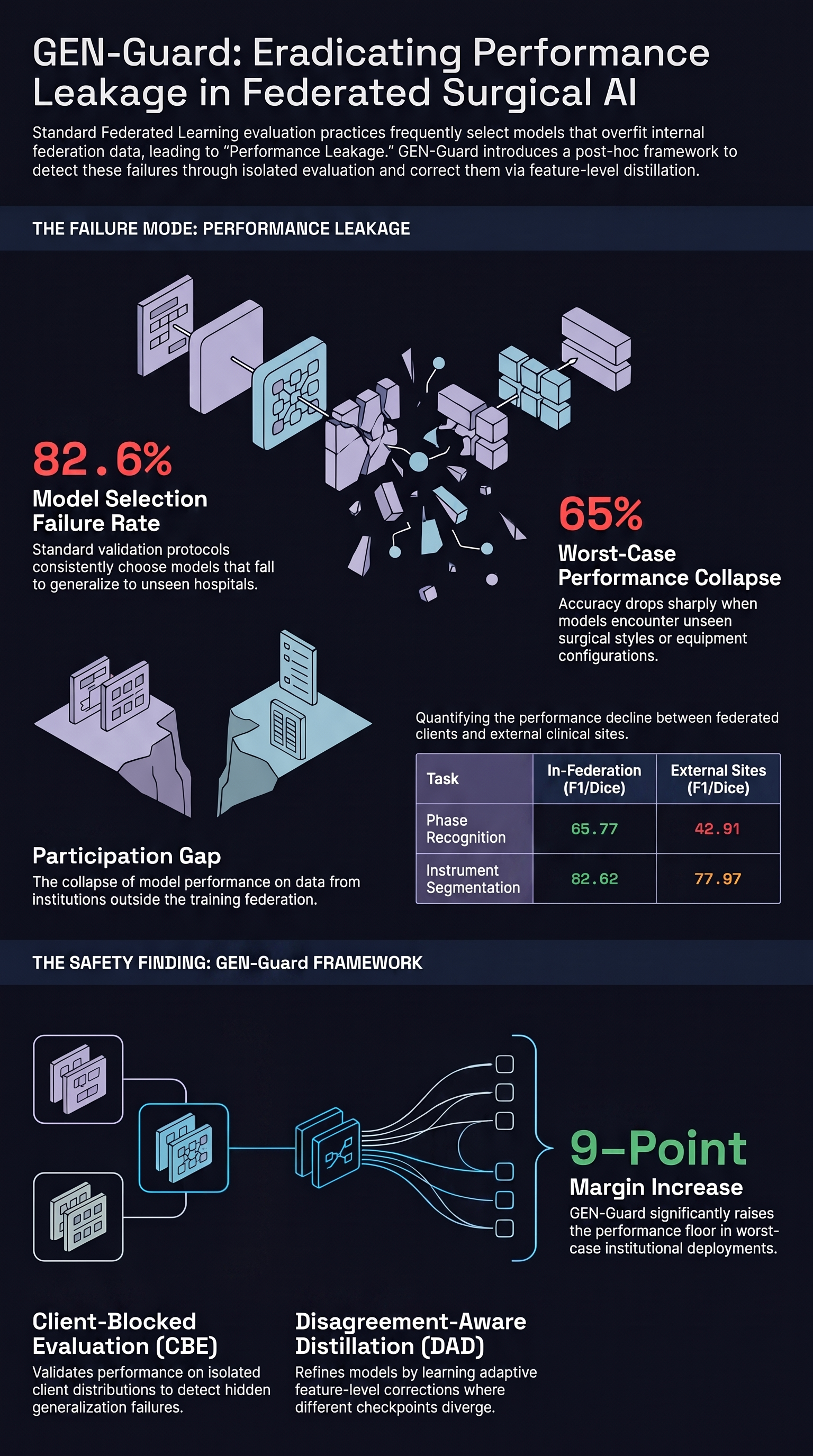
1. The “Participation Gap”: Why Collaborative AI Often Fails in the Real World
Federated Learning (FL) offers a compelling promise for surgical AI: the ability to train robust models on decentralized, multi-institutional data without ever sharing sensitive patient video. By aggregating knowledge while preserving privacy, FL aims to overcome the data scarcity and regulatory hurdles that plague specialized medical domains.
However, recent empirical research reports a marked performance drop when these models move from the “federation” (the hospitals used for training) to “unseen” clinical sites. This failure occurs across two primary dimensions:
- Out-of-Sample Gap: Performance degradation when encountering new data from hospitals already participating in the training federation.
- Participation Gap: A critical collapse in performance when the model is deployed at an entirely new institution with a unique clinical distribution.
In surgical phase recognition, external-site evaluation can cause performance to drop by as much as 23% compared to in-federation metrics. The GEN-Guard framework addresses this “Participation Gap,” targeting the reliability drop that occurs when models encounter unseen clinical environments.
2. The Hidden Culprit: Performance Leakage and Model Selection Failure (MSF)
Standard FL practice typically selects the “best” model based on internal validation data pooled from participating clients. This approach introduces a systematic risk known as Performance Leakage.
Performance leakage occurs when a model overfits the internal signatures and site-specific artifacts of the federation’s data. The model appears stable and accurate on known clients but lacks true generalization. This leads to Model Selection Failure (MSF)—the deployment of a model that is suboptimal for the real world because its selection was guided by a biased proxy.
The Internal Validation Trap Choosing a model based only on internal federation data is a biased proxy for real-world reliability. Internal metrics often suggest a model has “converged” when it has actually just mastered the unique imaging signatures of the training participants.
The severity of this issue is stark: empirical testing across 46 experimental runs revealed that 82.6% of standard FL runs suffered from Model Selection Failure, picking a checkpoint that was not the optimal version for external deployment.
3. The “Unit” Analogy: Mapping Hidden Biases in Surgical Video
Surgical data is uniquely prone to generalization failure because it is shaped by a hierarchy of “States & Processes” (S/P) that create a distinct institutional fingerprint. Each hospital acts as a “correlated data unit,” violating the Independent and Identically Distributed (IID) assumptions foundational to most ML:
- Grandparent S/P (Surgeon Characteristics): Skill levels, decision-making styles, and execution patterns that dictate procedural rhythm.
- Parent S/P (Surgical Setup): Physical variables such as the brand of endoscope, sensor type, light source, and tool choices.
- Child S/P (Video Data): The resulting visual patterns. Site-specific artifacts (e.g., a specific endoscope’s color rendering or a unique tool brand) become “Internal Signatures” that the model learns to rely on.
When a model is validated on pooled data from these “Units,” it is encouraged to capture the very site-specific signatures it should ignore, leading to inflated internal scores but poor external robustness.
4. GEN-Guard: A Two-Step Framework for Robust Deployment
GEN-Guard is a post-hoc, privacy-preserving framework designed to operate after standard FL training. It identifies and corrects generalization failures before deployment.
4.1. Detection via Client-Blocked Evaluation (CBE)
CBE rejects the assumption that mixed-client validation predicts external performance. Instead, it isolates one client from training to serve as a “worst-case” proxy for domain shift.
- Conventional Selection: Chooses the model that performs best on a mix of all participating validation data.
- CBE Selection: Maximizes performance on the isolated client. By forcing the model to perform “blindly” on a novel distribution, the framework prioritizes domain-invariant features over site-specific artifacts.
4.2. Correction via Disagreement-Aware Distillation (DAD)
Once the robust CBE model is identified, the DAD pipeline transfers its feature-level knowledge to the conventional model. Crucially, GEN-Guard achieves this without requiring supervised labels on the deployment site, utilizing a “label-free” signal to achieve robustness comparable to personalized models like FedBN or pFedMe.
To refine the model, DAD utilizes a Temperature Differential. It applies a higher temperature () and higher weight () to samples where the two models disagree. This “Disagreement Focus” forces the conventional model to unlearn the institutional biases it acquired during the initial federation training.
5. Empirical Evidence: Phase Recognition and Polyp Segmentation
GEN-Guard was validated on two multi-center clinical challenges: Multi-Cholec (surgical phase recognition across centers including Gemelli, Sant’Andrea, Ca’ Granda, and Monaldi) and PolypGen (multi-center polyp segmentation).
The primary metric of interest for AI safety is “Worst-Case F1,” which represents the “Safety Floor”—the performance on the most challenging, outlier institution.
Worst-Case Out-of-Federation F1 Correction
| Task | Protocol (Surgical-Specific FL) | Conventional F1 | GEN-Guard F1 | Improvement (Delta) |
|---|---|---|---|---|
| Phase Recognition | FedAvg | 62.46 | 65.51 | +3.05 |
| Phase Recognition | FedProx | 54.57 | 63.50 | +8.93 |
| Phase Recognition | SCAFFOLD | 62.49 | 66.53 | +4.04 |
| Polyp Segmentation | FedAvg | 88.31 | 90.94 | +2.63 |
| Polyp Segmentation | FedProx | 79.95 | 83.78 | +3.83 |
| Polyp Segmentation | SCAFFOLD | 78.34 | 81.94 | +3.60 |
Qualitatively, GEN-Guard reduces “spiky” misclassifications. These errors typically occur during transitional phases (e.g., the shift from clipping to retraction), where a safety-critical system is most likely to provide a false alert.
6. Efficiency and Clinical Implications
GEN-Guard is designed for real-world clinical practicality, maintaining a minimal computational footprint.
- Zero Additional Communication: The framework is post-hoc; it requires no extra synchronization rounds between hospitals after the main FL training ends.
- Reduced VRAM Footprint: During the DAD correction phase for PolypGen, peak memory usage was 453.13 MB, down from the 2.6 GB required during standard training.
- Real-Time Performance: Reported inference speed remains high (e.g., 116 FPS), which the authors position as compatible with intraoperative use.
By acting as a “validation safeguard,” GEN-Guard is intended to reduce the risk of AI failures caused by unseen imaging equipment or procedural styles. The paper reports offline benchmark gains; it does not evaluate patient outcomes, so any clinical safety benefit remains untested.
7. Conclusion: Strengthening the Future of Surgical AI
GEN-Guard suggests that generalization failures can be mitigated without redesigning the entire training protocol. Across the six task/protocol pairs reported above, moving beyond internal-only validation recovered between +2.63 and +8.93 worst-case F1 at unseen sites — a meaningful correction to the “Safety Floor,” though one measured on two datasets rather than across surgical AI generally.
Key Takeaways:
- Internal validation is not enough: Performance on federation clients is often a misleading proxy for real-world reliability.
- Prioritize Invariance: Robustness requires models to ignore site-specific “Internal Signatures” and focus on universal procedural patterns.
- Label-Free Generalization is Possible: GEN-Guard achieves the benefits of personalized models without the need for expensive expert-annotated labels at every deployment site.
- Post-hoc Correction is Practical: You can fix “Safety Floor” collapses efficiently after training has concluded.
As AI enters the operating room, robust validation frameworks like GEN-Guard—paired with continuous post-deployment monitoring—look increasingly relevant to surgical safety practice.
Read the full paper on arXiv · PDF