Fail-RAG : A Retrieval Augmented Generation Informed Framework for Robot Failure Identification
Industry automation is witnessing an evolution in robotics driven by both technological breakthroughs and societal changes: progress towards generalist robots, embodied and physical artificial...
1. Introduction: The Brittle Reality of Industrial Automation
Industrial automation is shifting from static, highly controlled assembly lines toward generalist physical AI intended to operate in the unstructured environments of logistics warehouses and healthcare facilities. As robots move into these dynamic settings, the paper argues that the scope for “unexpected events”—operational failures—widens accordingly.
Traditional failure detection has long relied on rigid rule-based systems or specialized hardware. The authors argue these legacy methods struggle with the fluid nature of modern material handling, where the morphology of a failure can vary with lighting, payload, or environment. The paper proposes “Fail-RAG” as an alternative that bridges off-the-shelf Vision-Language Models (VLMs) and the demands of industrial robustness, aiming to provide a detection layer without the “fine-tuning tax” the authors identify as a barrier to deployment.
2. The Bottleneck to the Democratization of Physical AI
Existing state-of-the-art (SOTA) failure detection frameworks, such as FailSafe and AHA, perform well but face a scaling problem. The paper identifies two bottlenecks introduced by the reliance on fine-tuning large models:
- The Vision-Action Data Gap: Fine-tuning demands large curated datasets of paired vision and action data specific to failure scenarios. In industrial settings, the authors note that sourcing this data is difficult and expensive.
- High Computational Tax: Tuning models with billions of parameters requires substantial compute clusters. This makes it nearly impossible for onsite engineers to iterate quickly as new edge cases—such as novel packaging materials or shifting warehouse layouts—appear in the field.
While rule-based systems are computationally efficient, they lack the semantic reasoning required to understand why a failure occurred. In the pursuit of autonomous resilience, a system that cannot reason is a system that remains reactive rather than proactive.
3. Inside Fail-RAG: Architecture and Methodology
The Framework Overview
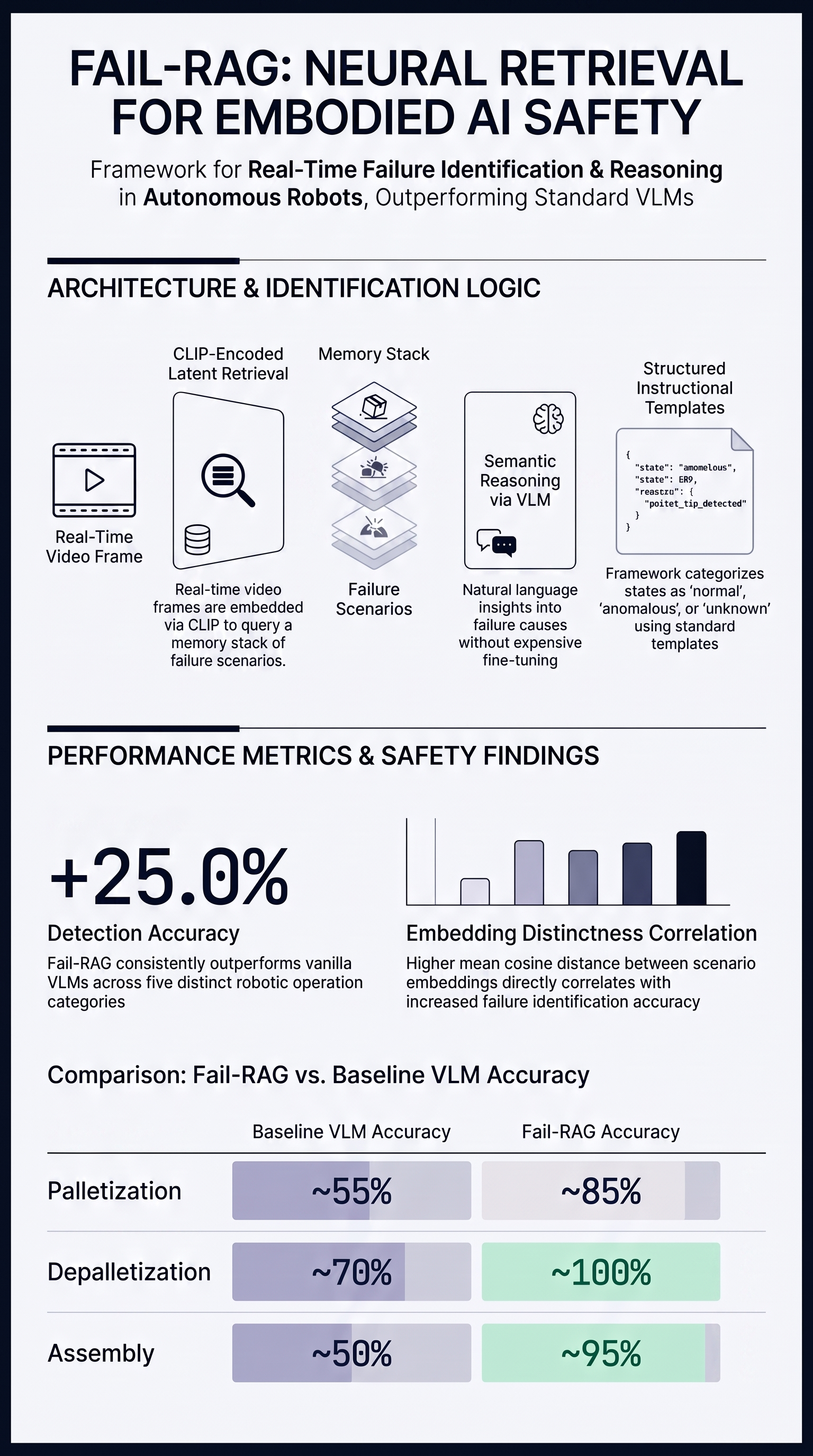
Fail-RAG transforms failure detection into an agentic assessment pipeline. The system processes a live video stream, compiling sequential frames into a single temporal snapshot. This sequence is then transformed into a multi-modal embedding to query a pre-compiled failure database, providing the VLM with the “contextual anchor” it needs to make a high-confidence judgment without prior training on that specific environment.
The Power of CLIP Embeddings
The framework leverages the Contrastive Language-Image Pre-Training (CLIP) encoder (specifically ViT-B-32) to create a shared latent space for visual and textual data. By converting time-sequenced images and their ground-truth failure descriptions into a shared “memory stash,” Fail-RAG allows the VLM to retrieve past experiences that semantically match the current stream.
Mathematical Precision: Distance Metrics
The reliability of retrieval depends entirely on the distance metric used to navigate the latent space. Fail-RAG evaluates three primary metrics, with vector orientation proving more critical than magnitude for multi-modal accuracy:
| Metric | Formula | Description |
|---|---|---|
| Cosine Similarity | $\frac{u_1 \cdot u_2}{ | |
| L2 Distance | $ | |
| Dot Product | Measures the product of magnitudes and the cosine of the angle between vectors. |
Experimental data identifies Cosine Similarity as the preferred metric for Fail-RAG, as it maintains consistency across the divergent distributions of image and text-based embeddings.
Reinforced Instruction Structuring
To bridge the gap between AI reasoning and industrial execution, Fail-RAG utilizes a structured JSON template. This ensures that the VLM’s assessment is immediately actionable for safety APIs. The model must populate four attributes:
- Failure types: Categorical objects such as
robot-arm,loading pallet, orflipping-station. - Deterministic status: Constrained to
normal,anomalous, orunknownto eliminate ambiguous natural language. - Sub-failure: Specific technical attributes, such as
suction-gripper failureormotion singularity. - Natural language reason: An unconstrained explanation providing the “why” for human intervention and debugging.
4. Putting Fail-RAG to the Test: Experimental Environments
Validation was conducted across five complex setups, mapping specific hardware to high-stakes industrial tasks. The framework utilized task-specific sampling frequencies to optimize the trade-off between information density and computational load:
- Palletization (Sim - UR5): Handling irregular boxes in Nvidia Isaac Sim. Focused on flipping-station errors at low sampling rates (0.05 Hz to 0.27 Hz).
- MoMa Transport (Sim - Clearpath Ridgeback + Franka): Transporting goods with a mobile manipulator, where payload instability is the dominant failure mode (0.5 Hz to 2.5 Hz).
- MoMa Traverse (Sim - Clearpath Ridgeback + Franka): Navigating between points under unmapped layout changes (0.5 Hz to 2.5 Hz).
- Depalletization (Physical - Fanuc M-20iB): Picking cardboard and shrink-wrapped items where plastic material often causes picking failures (0.5 Hz to 2.5 Hz).
- Assembly (Physical - UR5): Identifying component misalignment in mechanical kits due to workstation setup inaccuracies (0.2 Hz to 1 Hz).
5. Key Findings: Rescuing Performance in the Real World
When benchmarked against the off-the-shelf Qwen2.5-VL:32b baseline, Fail-RAG reported an average 25 percentage point increase in failure detection accuracy across the five operations, rising to as much as 40% in some operations.
Notably, the paper reports larger gains in physical environments than in simulation. Where the baseline VLM degrades under real-world lighting variability and shadows, Fail-RAG acts as a contextual anchor: retrieving relevant historical failures helps disambiguate environmental noise that would otherwise produce false negatives in a zero-shot model.
6. Deep Dive: Embedding Distance and the Mitigation of Misclassification Risk
For AI safety practitioners, the “Mean Cosine Distance” is more than a mathematical curiosity—it is a metric for reliability. The paper’s analysis of latent space heatmaps indicates that the diversity of the RAG database affects safety outcomes.
High mean cosine distance indicates that failure modes (e.g., a “motion singularity” vs. a “payload drop”) are encoded as distinct, non-overlapping vectors. If these embeddings are too close in latent space, the Misclassification Risk increases, potentially triggering the wrong safety protocol (such as an emergency stop when only a minor recalibration is needed). A diverse RAG database ensures that the VLM can clearly differentiate between failure modes, which is a fundamental requirement for autonomous intervention and reliable safety-critical decision-making.
7. Future Directions: From Identification to Preemption
While Fail-RAG reduces the effort required for robust detection, a remaining challenge is the latency introduced by compiling frame sequences. The authors frame the next step as a shift from reactive Failure Identification to proactive Failure Preemption.
The paper identifies two directions:
- Latent Space Prediction: Identifying early indicators of failure within the embedding space before they manifest as physical anomalies.
- Multi-View Synthesis: Introducing dynamic operational views to achieve high-confidence assessments with fewer frames, thereby reducing the detection delay.
8. Conclusion: Takeaways for AI Safety Practitioners
Fail-RAG suggests that industrial-grade resilience may not require the compute cost of fine-tuning. In the setups reported here, augmenting off-the-shelf multi-modal models with a curated retrieval database improved detection accuracy without a training pass.
Key Takeaways:
- Fine-tuning is a Choice, Not a Necessity: Fail-RAG offers a low-compute, high-accuracy alternative for identifying edge-case failures in the field.
- RAG Rescues Physical Performance: The framework is most effective in high-noise, real-world environments where vanilla VLMs typically struggle with lighting and shadows.
- Latent Diversity is Safety: Maximizing the cosine distance between failure modes in the RAG database is essential for reducing misclassification risk and ensuring reliable autonomous protocols.
Read the full paper on arXiv · PDF