Qwen-RobotManip Technical Report: Alignment Unlocks Scale for Robotic Manipulation Foundation Models
Foundation models in language and multimodality achieve strong generalization by aligning heterogeneous data under a unified formulation and training at scale.
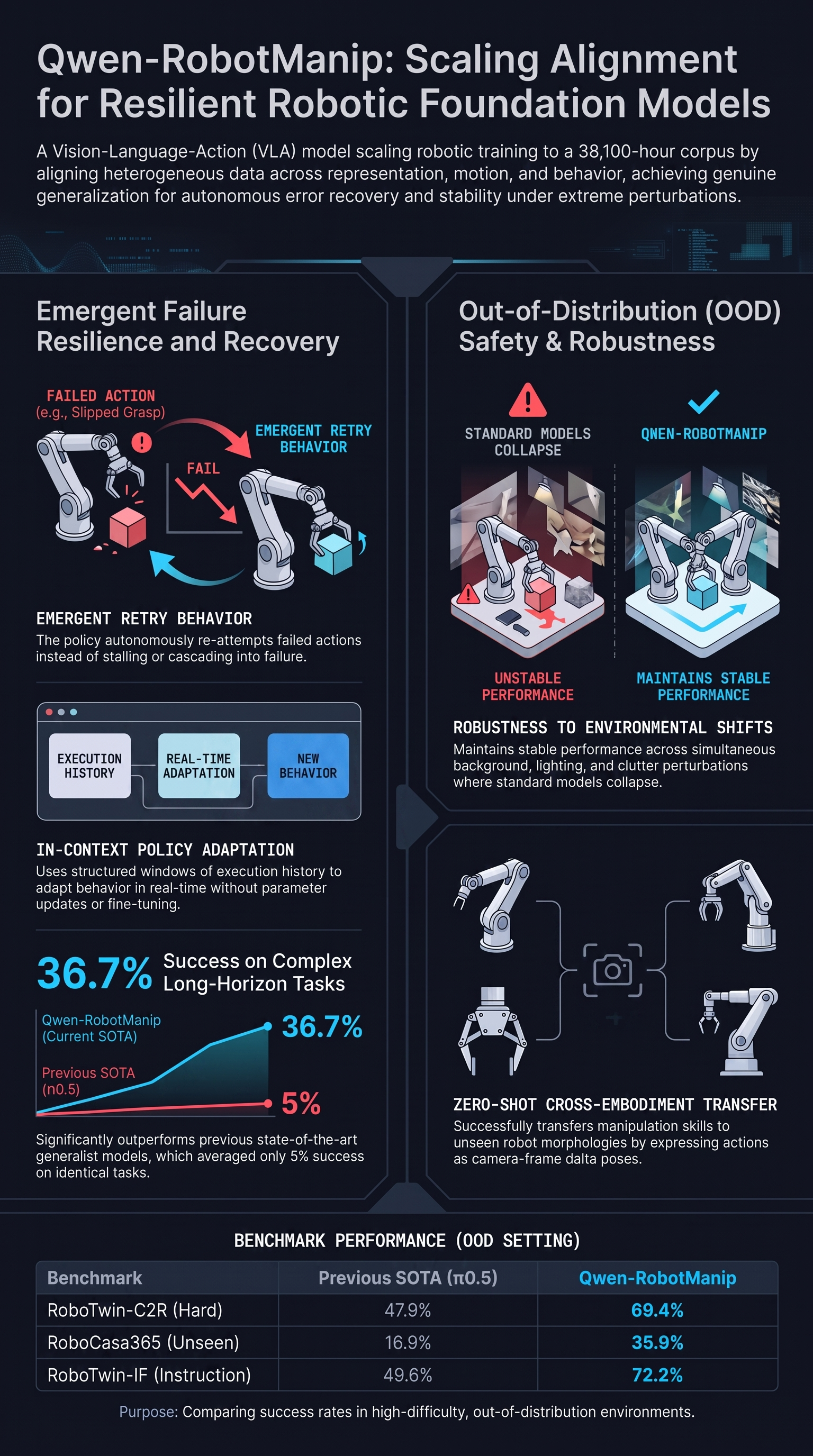
For years, the robotics community has been chasing a ghost. We watched in awe as Large Language Models (LLMs) unlocked emergent reasoning by simply feeding massive, heterogeneous datasets into a unified architecture. We tried to replicate this “scaling recipe” in robotics, only to hit what I call the “Data Wall.” While text is a universal medium, robotic data is trapped in silos—fragmented by hardware, expensive to collect, and frustratingly narrow.
Today, that changes. We are introducing Qwen-RobotManip, a Vision-Language-Action (VLA) foundation model built upon the Qwen-VL architecture. Our research demonstrates a fundamental paradigm shift: Alignment first, then scale. We have proven that scaling only works when heterogeneous data—from different robots, simulators, and even “embodiment-free” human videos—is unified under a single, coherent framework. By breaking the data wall through alignment, we have finally brought the scaling laws of AI to the physical world.
The Problem: Why Robotics Isn’t Just “LLMs for Motion”
In the LLM world, a token is a token. In robotics, an “action” is a nightmare of heterogeneity. A trajectory recorded for a Franka arm is meaningless to an ALOHA platform or a humanoid without a translator. This creates three existential challenges:
- The Heterogeneity Gap: Diverse embodiments have fundamentally incompatible observation and action representations.
- The Cost of Teleoperation: Collecting high-quality robot data is labor-intensive and notoriously difficult to scale compared to scraping the web.
- The Diversity Deficit: Most datasets are confined to specific lab settings, leading to models that are “experts of the basement” but fail in the kitchen.
Furthermore, we must stop over-relying on “Standard Benchmarks” (like the original LIBERO). In our view, these are often “vanity metrics” that provide a false sense of security. Here is why they mislead:
- In-Distribution Memorization: Because training and testing often occur in the same environment, models memorize visual patterns rather than learning “how to manipulate.”
- Superficial Generalization: Performance frequently collapses when faced with minor shifts in lighting, background, or camera angles.
- The Language Shortcut: Without rigorous testing, models become “vision-action pattern matchers,” ignoring language instructions in favor of visual heuristics.
The Solution: A Unified Alignment Framework
To bridge these gaps, Qwen-RobotManip utilizes a unified alignment framework across three dimensions. This is the “glue” that allows us to turn 15 different robot platforms into a unified fleet.
- Representation Alignment (The 80-Dimensional Template): We introduce an 80-dimensional canonical state-action vector that acts as a universal template. By using per-dimension binary masking, we accommodate any morphology—from single-arm grippers to dual-arm setups and dexterous hands—within the same numerical space.
- Motion Alignment (Camera-Frame Delta Poses): We have moved beyond coordinate frame inconsistencies by grounding all end-effector actions in camera-frame delta poses. This is critical: it makes visually similar motions numerically proximate. By doing so, we allow the model to extract “cross-embodiment synergies,” learning the “essence of a grasp” regardless of the robot’s base frame or physical dimensions.
- Behavior Alignment (In-Context Policy Adaptation): We equip the model with a history-aware adaptation mechanism. By reading the intra-episode execution history, the model uses history as an implicit embodiment identifier. Crucially, we utilize stochastic context sampling during training. Without randomizing this history window, models learn a “copy-paste” heuristic; with it, they achieve genuine behavioral adaptation to the environment and hardware.
The 38,100-Hour Data Engine
Scaling requires fuel. We have constructed a massive pretraining corpus of approximately 38,100 hours using exclusively open-source datasets (like OXE, DROID, and RH20T) and human video data.
| Data Type | Embodiment Type | Total Time |
|---|---|---|
| Robot Data | Single-arm Tabletop | 3,808 h |
| Robot Data | Dual-arm Tabletop | 6,744 h |
| Robot Data | Mobile & Humanoid | 868 h |
| Human Data | Human hands (EgoDex, VITRA, etc.) | 1,933 h |
| Human-to-Robot | 15 synthesized dual-arm platforms | 24,808 h |
The core of our “embodiment-free fuel” is the Human-to-Robot Synthesis Pipeline. We transform egocentric human videos into robot trajectories using a two-stage process:
- Action Alignment: Retargeting human hand trajectories to robot end-effector spaces.
- Visual Alignment: We use SAM3 and ProPainter to segment human hands and replace them with 3D-rendered robot models. This isn’t just for aesthetics; it removes “morphology interference,” ensuring the model focuses only on the “robot logic” of the task.
Advanced Training: Keeping the “Brain” Sharp
A common failure in VLA training is “VLA-to-VA degradation,” where the model becomes a specialized “muscle” but loses its “brain”—the linguistic reasoning and perceptual depth of the original VLM. To prevent this, we utilize a Dual-Stream Co-Training strategy with a strict 9:1 ratio of robot data to vision-language (VL) data. This stream includes 28 million VL data points to maintain cognitive scale.
Our architecture pairs the Qwen-VL backbone (the brain) with a Diffusion Transformer (DiT) action expert (the muscle). The DiT uses 4 Euler integration steps at inference to achieve low-latency, real-time control. We further bridge the gap with Embodied Chain-of-Thought (ECoT), where the model actually “thinks” in text—describing the scene and assessing task progress—before the DiT executes the movement.
Redefining Success: Out-of-Distribution (OOD) Performance
We believe in-distribution success is a trap. The true “north star” is Out-of-Distribution (OOD) generalization. Qwen-RobotManip achieved a 20% relative improvement over the previous state-of-the-art in the RoboChallenge generalist track.
Beyond raw scores, we observed several Emergent Capabilities:
- Zero-Shot Instruction Following: The model conditions on language as a genuine control signal, even with unseen instruction templates.
- Reactive Error Recovery: The ability to sense a failed grasp or perturbation and autonomously retry the action.
- Cross-Embodiment Transfer: We demonstrated successful zero-shot transfer from trained platforms like ALOHA to entirely unseen ones, such as the ARX-X5 and UR5, with 3.2x better performance than prior models like .
Real-World Validation
Generalization in simulation is a prerequisite, but the real world is the ultimate judge. We validated Qwen-RobotManip on four distinct physical platforms: AgileX ALOHA, Franka, UR, and ARX. These results hold under messy, unpredictable real-world deployment conditions, confirming that our alignment and scaling principles translate directly to physical reality.
Conclusion & Key Takeaways
Qwen-RobotManip proves that the robotics community was not missing data—we were missing alignment. By unifying how we represent motion and behavior, we have unlocked the ability for VLA models to treat the entire world of robotic and human data as a single, coherent teacher.
TL;DR
- Alignment is the Prerequisite to Scale: Scaling fails without a unified framework. Our 80D representation and camera-frame deltas allow us to turn 38,100 hours of fragmented data into a cohesive learning signal.
- The 9:1 Recipe: Co-training with a 9:1 ratio of robot data to general VL data (28M points) prevents the model from losing its reasoning capabilities.
- Human Data is Valid Fuel: Our synthesis pipeline removes morphology interference, turning 1,933 hours of human video into nearly 25,000 hours of high-quality robot training data.
- OOD is the True Metric: We must stop optimizing for “memorization benchmarks.” Genuine success is measured by zero-shot transfer to unseen robots like the UR5 or ARX-X5.
The future of general-purpose robotics depends on our willingness to test beyond the familiar. Qwen-RobotManip is just the beginning.
Read the full paper on arXiv · PDF