Y-BotFrame: An Extensible Embodied Agent Framework for Quadruped Robot Assistants
Quadruped robots are capable of traversing a wide range of complex terrains with high flexibility.
1. Introduction: The Evolution of Quadruped Intelligence
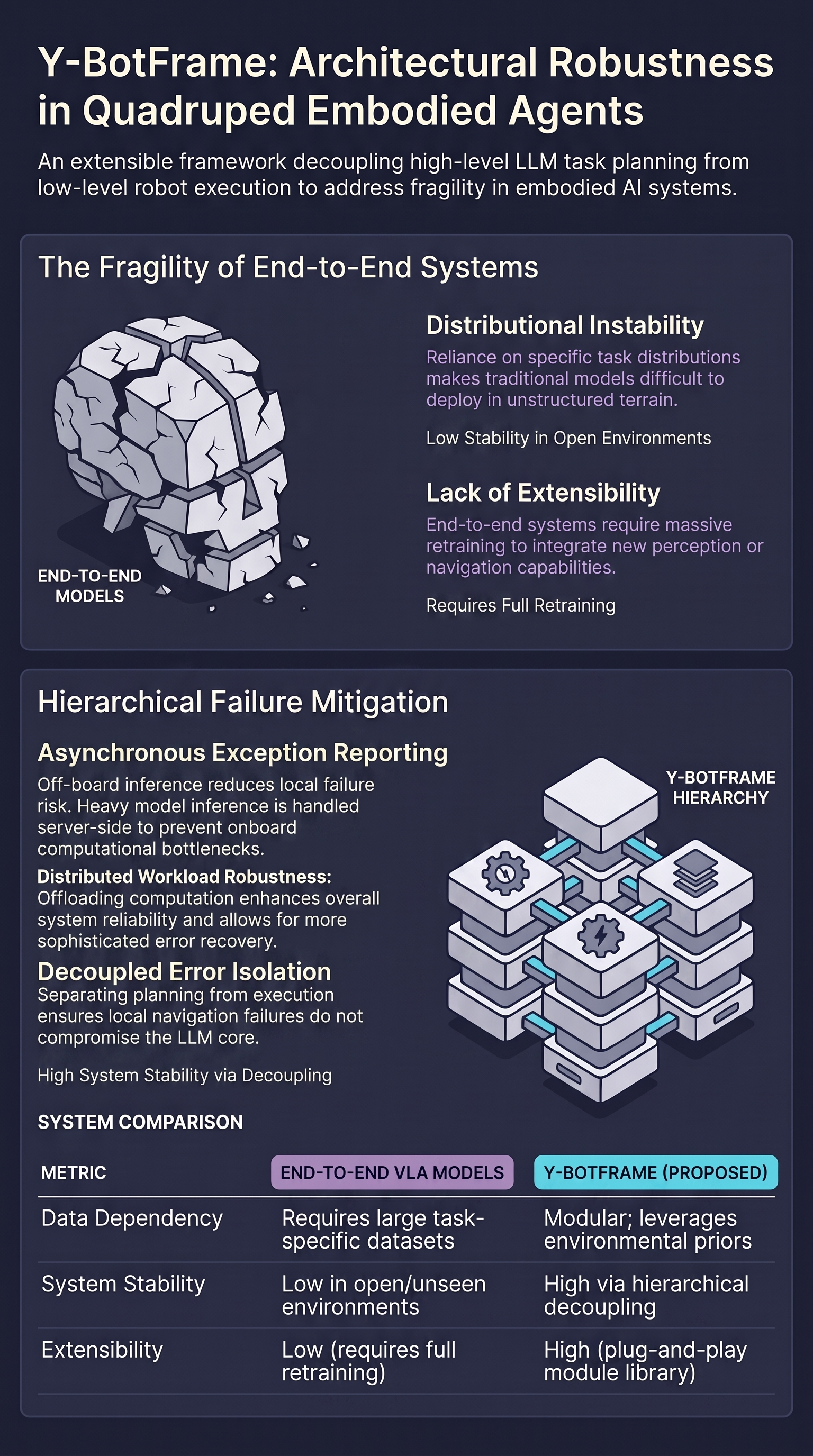
Quadruped robots have demonstrated significant potential as highly mobile platforms capable of traversing complex and unstructured terrains, such as stairs, gravel paths, and grasslands. According to Zhang et al., these robots offer superior mobility and flexibility compared to traditional wheeled systems, positioning them as ideal candidates for deployment as general-purpose embodied assistants. However, the researchers observe that most contemporary systems rely on end-to-end vision-language-action (VLA) models. While promising, these models often suffer from a heavy dependence on large-scale, task-specific training data and lack the interpretability required for safety-critical applications.
The paper introduces Y-BotFrame, an extensible embodied framework designed as a hierarchical alternative to monolithic end-to-end architectures. By decoupling high-level semantic reasoning from low-level physical execution, the framework aims to provide a more stable and interpretable deployment path for robotic assistants. This analysis examines the system’s architectural blueprint, its core modular capabilities, and the robustness implications of its failure-first design principles.
2. The Architectural Blueprint: Hierarchical Decoupling
The Y-BotFrame architecture is characterized by a hierarchical structure that separates the cognitive “Upper Level” from the operational “Lower Level.” This design, as described by Zhang et al., is intended to reduce the computational and data-driven bottlenecks inherent in end-to-end systems.
- LLM Task Planner (Upper Level): The paper specifies that the cognitive core consists of a single large language model (LLM) acting as a task orchestrator. This planner maps natural language instructions into executable “task units” by querying a module interface library. The library contains structured descriptions of callable functions, including their specific input parameters, applicable conditions, and execution constraints. To maintain contextual awareness during complex tasks, the planner references historical execution logs and environmental priors.
- Tool Factory (Lower Level): The lower level comprises a modular “Tool Factory” where robot capabilities are encapsulated into discrete functional units. Each module operates through standardized input and output interfaces, allowing the LLM to invoke specific capabilities—such as movement or visual analysis—without requiring knowledge of the underlying motor control logic.
The authors highlight several advantages of this hierarchical approach over end-to-end models:
- Reduced Data Dependency: By using pre-trained LLMs for reasoning and modular controllers for action, the system avoids the need for massive, task-specific datasets.
- Enhanced Interpretability: The separation of tasks into discrete units allows operators to monitor the reasoning process and pinpoint exactly where a failure occurs.
- Plug-and-Play Extensibility: The paper notes that new functional modules can be integrated or upgraded iteratively without retraining the entire cognitive architecture.
3. Core Capabilities: The Tool Factory Breakdown
The Tool Factory provides the specialized interfaces that allow the LLM to translate abstract intent into physical outcomes. The paper provides a detailed technical breakdown of three primary modules:
Speech Interaction This module facilitates human-robot collaboration through Automatic Speech Recognition (ASR) and Text-to-Speech (TTS). The authors describe a workflow where an LLM handles dialogue understanding and response generation. To support long-term interactions, the module utilizes dialogue memory and a domain-specific knowledge base, allowing the robot to function as a persistent assistant rather than a reactive tool.
Autonomous Navigation For mobility, the framework utilizes a technical stack consisting of LiDAR, GNSS, and IMU data fusion for global positioning. The system generates a local obstacle-aware grid map from LiDAR point clouds and employs the A algorithm* for path planning. According to the paper, these maps and paths are updated in real-time, enabling the robot to navigate complex environments safely even in the absence of pre-built maps.
Embodied Question Answering (EQA) The EQA module allows the robot to perform spatial reasoning and object identification. Upon reaching a target location, the robot performs a rotational scan and captures multi-view RGB observations. The framework utilizes Qwen3-VL-Flash for visual understanding. Crucially, Zhang et al. specify that the system generates a final answer by fusing these visual observations with the user’s original question and the specific viewing angles captured during the scan, ensuring spatial accuracy in the response.
4. Distributed Infrastructure and Deployment Flexibility
Y-BotFrame implements a server-client model to balance computational requirements with real-time responsiveness. In this infrastructure, the quadruped robot manages lightweight perception, motion control, and data transmission, while a remote server handles heavy model inference and complex visual understanding tasks.
The paper explains that the task planner invokes functional modules synchronously while receiving asynchronous feedback over a local area network (LAN). From a systems analyst perspective, this distributed design introduces a critical safety trade-off. While it allows the robot to leverage powerful vision-language models that exceed onboard hardware limits, the reliance on asynchronous LAN feedback introduces latency. This delay can have significant implications for real-time collision avoidance or immediate task termination if communication is interrupted. However, the authors argue that this modularity enhances operational efficiency by allowing the server-side models to be upgraded independently of the robot’s physical hardware.
5. Robustness and Failure-First Implications
A central contribution of the Y-BotFrame is its ability to isolate and manage failures. By separating semantic planning from physical execution, the framework allows for a “failure-first” analysis where cognitive errors can be distinguished from mechanical or algorithmic execution errors. The paper suggests that this modularity provides a safety buffer, as low-level modules can maintain real-time safety constraints even if the high-level LLM provides a logically flawed instruction.
Robustness Analysis: Modularity vs. End-to-End Systems
| System Feature | Design Choice | Failure/Safety Implication |
|---|---|---|
| Interpretability | Hierarchical Decoupling | Enables a distinction between “Cognitive Failure” (LLM semantic parsing error) and “Execution Failure” (A* pathfinding error). |
| Adaptability | Modular “Plug-and-Play” | Allows for iterative updates to specific failing modules (e.g., EQA vision) without destabilizing the core navigation or planning logic. |
| Constraint Handling | Low-level autonomy with A* algorithm | Real-time safety constraints are managed at the module level, preventing LLM hallucinations from causing immediate physical collisions. |
| Network Dependency | Asynchronous LAN Feedback | Introduces a primary failure point: high-latency or interrupted connectivity can delay feedback loops, impacting real-time responsiveness. |
| Environmental Perception | LiDAR-based grid mapping | Provides a robust physical fallback for navigation that does not rely on visual-semantic understanding, mitigating “vision-only” failures. |
6. Conclusion: Key Takeaways for AI Practitioners
The Y-BotFrame is presented by Zhang et al. as a “reference implementation” for the real-world deployment of instruction-driven embodied agents. By moving beyond the “black box” nature of end-to-end VLA models, the framework emphasizes an architecture where failure is both localized and interpretable.
For researchers and practitioners, the paper offers three critical insights:
- Semantic-Physical Isolation: Decoupling reasoning from execution through “task units” with defined input parameters and execution constraints is vital for debugging complex robot behaviors.
- Multimodal Fusion for Spatial Accuracy: The integration of viewing angles and multi-view RGB observations into the EQA workflow is essential for bridging the gap between 2D visual data and 3D physical environments.
- Distributed Robustness: While a server-client model enables high-level reasoning, the underlying architecture must ensure that low-level safety modules can operate autonomously to mitigate network-induced latency risks.
The authors conclude that such extensible frameworks are essential for bridging the gap between high-level LLM reasoning and the rigorous execution requirements of quadruped robots in open, unpredictable environments.
Read the full paper on arXiv · PDF