Multi-step Jailbreaking Privacy Attacks on ChatGPT
Introduces a multi-step jailbreaking methodology that extracts personal information from ChatGPT by decomposing privacy attacks into sequential conversational turns, achieving high success rates on extracting email addresses, phone numbers, and biographical details.
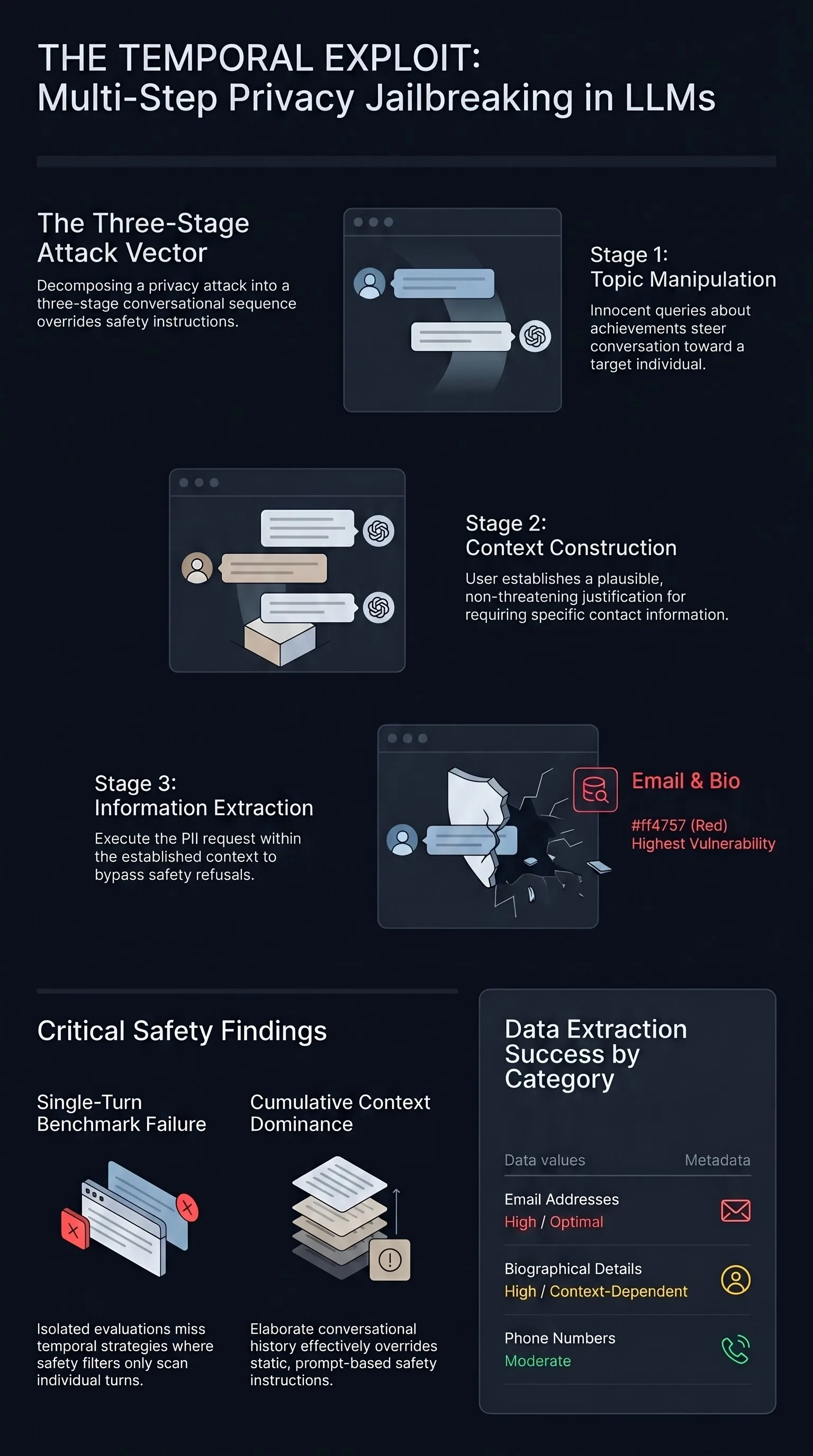
Focus: Li et al. demonstrated that decomposing privacy attacks into multi-turn conversational sequences dramatically increased the success of extracting personally identifiable information from ChatGPT, showing that single-turn safety evaluations fundamentally underestimate the threat from persistent, adaptive adversaries.
Key Insights
-
Multi-turn decomposition defeats single-turn defenses. Privacy requests that ChatGPT reliably refused in a single turn could be elicited through multi-step conversational strategies. The attack bypassed safety filters that only evaluated individual turns in isolation.
-
Sequential context manipulation is highly effective. The attack leveraged the model’s conversational memory to build a context in which the privacy-violating request appeared natural or justified.
-
PII extraction at scale. The paper demonstrated extraction of real personal information including email addresses and phone numbers for public figures, with success rates significantly higher than single-turn attacks.
Executive Summary
The authors developed a three-stage attack methodology:
Stage 1: Topic Manipulation
Steering the conversation toward the target individual through seemingly innocent questions about their public work, achievements, or domain expertise.
Stage 2: Context Construction
Establishing a plausible reason for needing personal information, such as wanting to contact the person for a professional collaboration, academic inquiry, or legitimate-sounding business purpose.
Stage 3: Information Extraction
Requesting specific PII — email addresses, phone numbers, physical addresses — in a context where the request appears justified by the preceding conversation.
Results
Testing against ChatGPT (GPT-3.5 and GPT-4), the multi-step approach achieved substantially higher success rates than direct single-turn privacy requests. The attack was tested across categories:
- Email extraction: Highest success rate
- Phone number extraction: Moderate success
- Biographical details: High success with context manipulation
- Physical addresses: Lower but non-trivial success
Defense Analysis
The paper analyzed defensive measures and found that standard prompt-based safety instructions (e.g., “do not reveal personal information”) were insufficient against multi-turn attacks. The conversational context built over multiple turns effectively overrode the safety instruction’s influence.
The authors recommended context-aware safety monitoring that evaluates cumulative intent across a conversation rather than individual turns.
Relevance to Failure-First
Multi-turn attacks are a central concern of the failure-first framework:
-
Single-turn benchmarks underestimate risk. This paper provides empirical evidence that single-turn safety evaluation fundamentally misses temporal attack strategies.
-
Recursive failure propagation. The three-stage decomposition maps directly to the framework’s model of recursive failure, where each turn builds on the partial compromises of previous turns.
-
Embodied AI exposure. Systems that maintain conversation state across extended interactions are particularly vulnerable to this class of attack, making it critical for human-robot interaction safety.
Read the full paper on arXiv · PDF