Constitutional AI: Harmlessness from AI Feedback
Introduces Constitutional AI (CAI), a method for training harmless AI systems using AI-generated feedback guided by a set of written principles, reducing dependence on human red-teaming while achieving comparable or better safety outcomes.
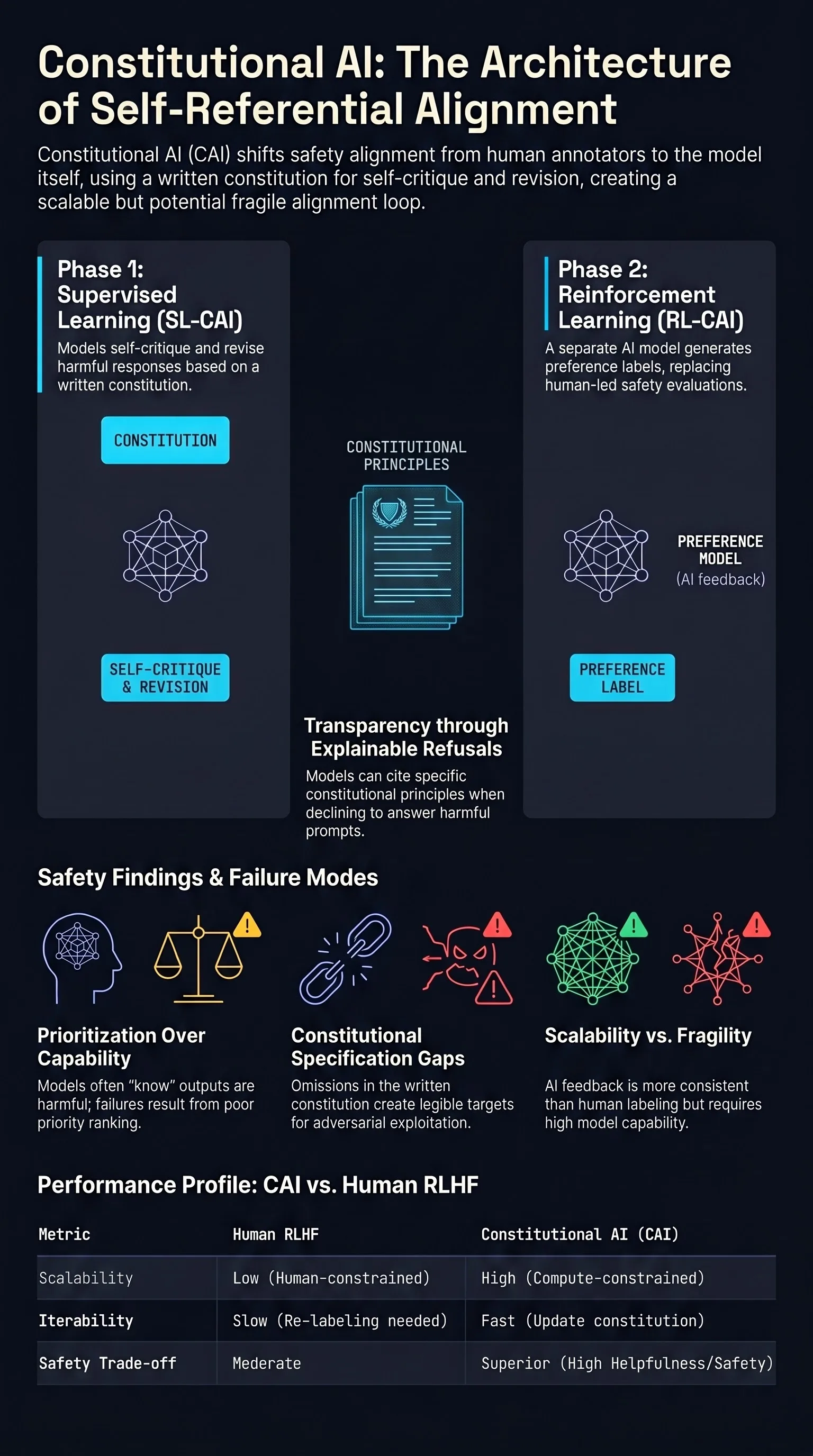
Focus: Bai et al. introduced Constitutional AI, where a language model critiques and revises its own outputs according to a set of written principles (the “constitution”), then uses these self-generated preference labels for RLHF training. This approach reduced reliance on human feedback for safety while raising new questions about self-referential alignment.
Key Insights
-
AI-generated feedback can substitute for human safety labels. By having the model critique its own outputs against written principles and then choosing the less harmful revision, CAI generated preference data for RLHF without requiring human annotators to evaluate harmful content.
-
The constitution is the alignment specification. Safety behavior was determined by the set of principles in the constitution. This made alignment more transparent and auditable — you can read the principles — but also more fragile, as adversaries can target gaps in the constitutional specification.
-
Self-critique improves without introducing new capabilities. The revision process reduced harmful outputs without adding new knowledge. This suggested that safety failures were often not capability limitations but prioritization failures.
Executive Summary
Constitutional AI operated in two phases:
Phase 1: Supervised Learning (SL-CAI)
The model generated responses to harmful prompts, then critiqued and revised those responses according to constitutional principles covering helpfulness, harmlessness, and honesty. The revision pairs (original harmful response, revised safe response) served as supervised training data.
Phase 2: Reinforcement Learning (RL-CAI)
The model generated pairs of responses to prompts, and a separate model judged which response better adhered to the constitution, generating preference labels for RLHF.
Results and Benefits
The approach yielded several practical benefits:
-
Better trade-offs. Models trained with CAI were both more helpful and less harmful than those trained with human-only RLHF.
-
Scalability. AI feedback was more consistent and could be generated at much larger scale than human feedback.
-
Iterability. The constitution could be updated and the model retrained without collecting new human data.
-
Transparent refusals. CAI models could explain which principle applied when declining harmful requests, making it easier to audit safety behavior.
Limitations
The authors acknowledged that the approach assumes the model has sufficient capability to accurately apply the constitutional principles — an assumption that may not hold for all types of harm or for models at smaller scales.
Relevance to Failure-First
Constitutional AI is significant for the failure-first framework for several reasons:
-
Explicit and attackable specifications. CAI makes the alignment specification explicit and therefore auditable — and targetable. If the constitution does not cover a particular failure mode, the model has no principled basis for refusing.
-
Specification gap testing. The framework’s adversarial evaluation specifically tests for gaps in safety specifications, and CAI makes those specifications legible.
-
Prioritization as vulnerability. The self-critique mechanism reveals that models often “know” their outputs are harmful but produce them anyway absent sufficient training signal. This has implications for adversarial attacks that manipulate the priority ordering between helpfulness and safety.
Read the full paper on arXiv · PDF