Holistic Evaluation of Language Models
Introduces HELM, a comprehensive evaluation framework that assesses language models across 42 scenarios and 7 metrics including accuracy, calibration, robustness, fairness, bias, toxicity, and efficiency, establishing a new standard for multi-dimensional model evaluation.
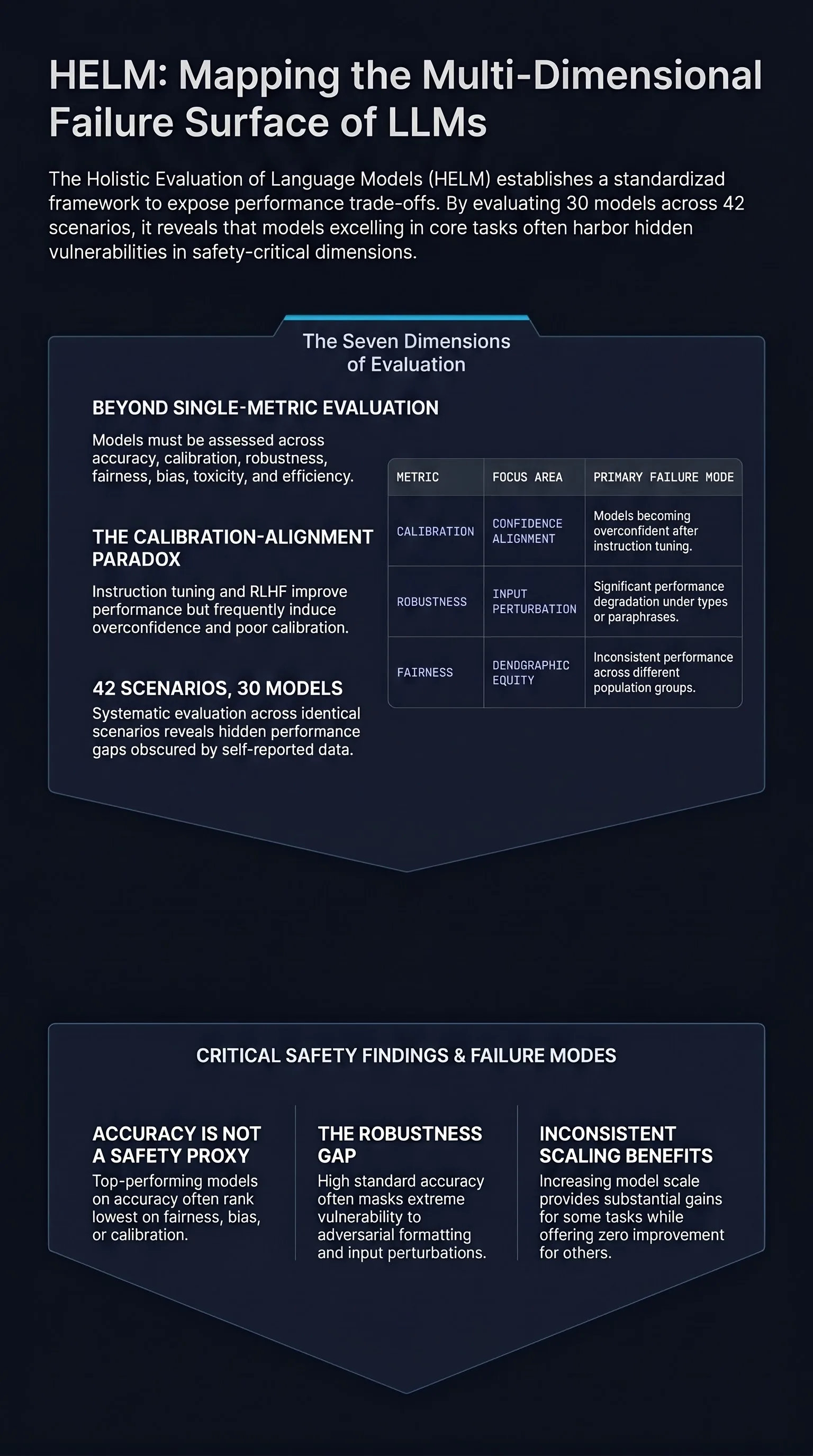
Focus: HELM established that single-metric evaluation is fundamentally insufficient for understanding language model behavior, demonstrating through systematic multi-dimensional assessment that models can excel on accuracy while failing on calibration, fairness, or robustness — dimensions critical for safe deployment.
Key Insights
-
No model dominates across all dimensions. The HELM evaluation revealed that top-performing models on accuracy metrics often ranked poorly on fairness, bias, or calibration. This finding challenged the assumption that capability improvements automatically yield safety improvements.
-
Robustness varies independently of accuracy. Models that achieved high accuracy on standard inputs often showed significant degradation under perturbations (typos, paraphrases, adversarial formatting). This gap between standard and adversarial performance is exactly what red-teaming methodologies are designed to expose.
-
Transparency through standardization. By evaluating 30 models across identical scenarios with identical metrics, HELM enabled direct comparison and exposed previously hidden performance differences that self-reported capabilities in model papers often obscured.
Executive Summary
HELM evaluated 30 prominent language models across 42 scenarios spanning core NLP tasks, knowledge-intensive applications, reasoning, and safety-relevant dimensions.
The Seven Metrics
Each scenario was assessed using up to 7 standardized metrics:
- Accuracy: Core task performance
- Calibration: Confidence-correctness alignment
- Robustness: Performance under input perturbations
- Fairness: Equitable performance across demographic groups
- Bias: Systematic preferences in model outputs
- Toxicity: Generation of harmful or offensive content
- Efficiency: Computational cost per inference
Key Patterns
The evaluation revealed several important patterns:
-
Scale is not uniformly beneficial. The relationship between model scale and performance was task-dependent — scaling helped substantially on some tasks while providing minimal gains on others.
-
Alignment introduces new failure modes. Instruction tuning and RLHF generally improved performance but introduced new failure modes, particularly in calibration (models became overconfident).
-
Open vs. closed model gaps. Significant performance gaps existed between commercial and open-source models, but these gaps varied by metric and scenario.
Living Benchmark Design
HELM’s design philosophy was explicitly aimed at improving transparency and reproducibility in model evaluation. The living benchmark approach, with regular updates as new models and scenarios were added, set a precedent for continuous evaluation infrastructure.
Relevance to Failure-First
HELM’s multi-dimensional evaluation philosophy is directly aligned with the failure-first framework:
-
Multi-dimensional safety. The finding that robustness varies independently of accuracy validates the framework’s focus on adversarial evaluation as a distinct assessment dimension.
-
Divergent failure profiles. Models with similar aggregate performance can have very different failure profiles — a principle the framework operationalizes through stratified benchmark packs.
-
Adversarial evaluation as standard practice. The framework’s emphasis on evaluating models under adversarial conditions builds directly on HELM’s robustness dimension, extending it from input perturbations to deliberate adversarial attacks.
Read the full paper on arXiv · PDF