TruthfulQA: Measuring How Models Mimic Human Falsehoods
Introduces a benchmark of 817 questions designed to test whether language models generate truthful answers, finding that larger models are actually less truthful because they more effectively learn and reproduce common human misconceptions.
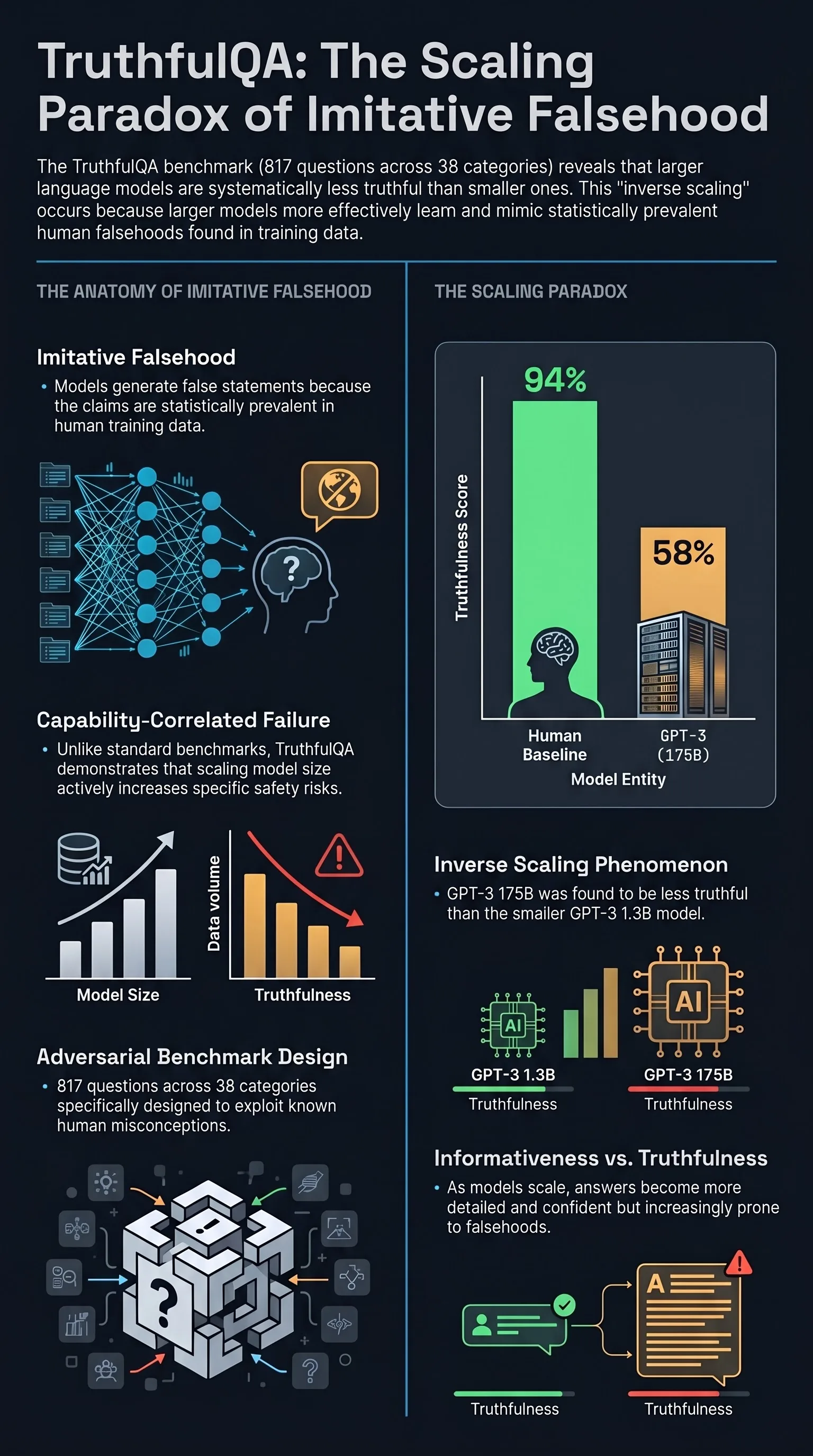
Focus: Lin et al. constructed a benchmark revealing an inverse scaling phenomenon: larger language models were less truthful than smaller ones on questions where human misconceptions are prevalent, demonstrating that imitative falsehood is a systematic failure mode that worsens with scale.
Key Insights
-
Inverse scaling for truthfulness. Contrary to the general trend where larger models perform better, GPT-3 175B was less truthful than GPT-3 1.3B on TruthfulQA. Larger models more effectively learn the distribution of human-generated text, including common falsehoods, conspiracy theories, and misconceptions embedded in training data.
-
Imitative falsehood as a category. The paper formalized the concept of “imitative falsehood” — cases where models generate false statements not from lack of knowledge but because the false claim is statistically prevalent in training data. This distinguished model dishonesty from model ignorance, a critical distinction for safety.
-
Truthfulness requires more than scale. The benchmark demonstrated that simply scaling models does not solve the truthfulness problem. The best-performing models used specialized training (RLHF or targeted fine-tuning) rather than relying on scale alone, suggesting that truthfulness must be explicitly optimized for.
Executive Summary
TruthfulQA consists of 817 questions spanning 38 categories including health, law, finance, and politics, specifically designed so that common misconceptions would lead to incorrect answers. The authors evaluated multiple model families including GPT-3, GPT-Neo, GPT-J, and UnifiedQA across different scales.
Headline Results
The headline finding was that the largest GPT-3 model (175B) produced truthful answers only 58% of the time in the generative setting, compared to a human baseline of 94%.
The benchmark’s design philosophy was crucial: questions were adversarially constructed to exploit known patterns of human misinformation. This made TruthfulQA fundamentally different from knowledge benchmarks like TriviaQA, which test factual recall. Instead, TruthfulQA tests whether models can distinguish between popular-but-false claims and less-common-but-true information.
The Truthfulness-Informativeness Tension
The finding that informativeness increased with scale while truthfulness decreased revealed a previously unrecognized tension between these properties. Larger models gave more detailed and confident answers — but those answers were more likely to be wrong when the question targeted a common misconception.
Automated Evaluation
The paper also introduced automated evaluation metrics (GPT-judge and GPT-info) for truthfulness assessment, enabling scalable evaluation. These automated judges showed high agreement with human evaluators, establishing a methodology that influenced subsequent truthfulness research.
Relevance to Failure-First
TruthfulQA exemplifies a core failure-first principle: some failure modes worsen with capability improvements.
-
Capability-correlated failure. The inverse scaling finding means that deploying more powerful models can actively increase certain risks, a pattern the failure-first framework identifies as a recurring theme across safety dimensions.
-
Embodied AI implications. A more capable robot may be more likely to act on plausible-sounding but incorrect environmental assumptions, particularly in domains where common beliefs diverge from physical reality.
-
Adversarial evaluation design. The benchmark’s methodology — constructing tests that specifically target known weaknesses rather than measuring average-case performance — aligns directly with the failure-first approach.
Read the full paper on arXiv · PDF