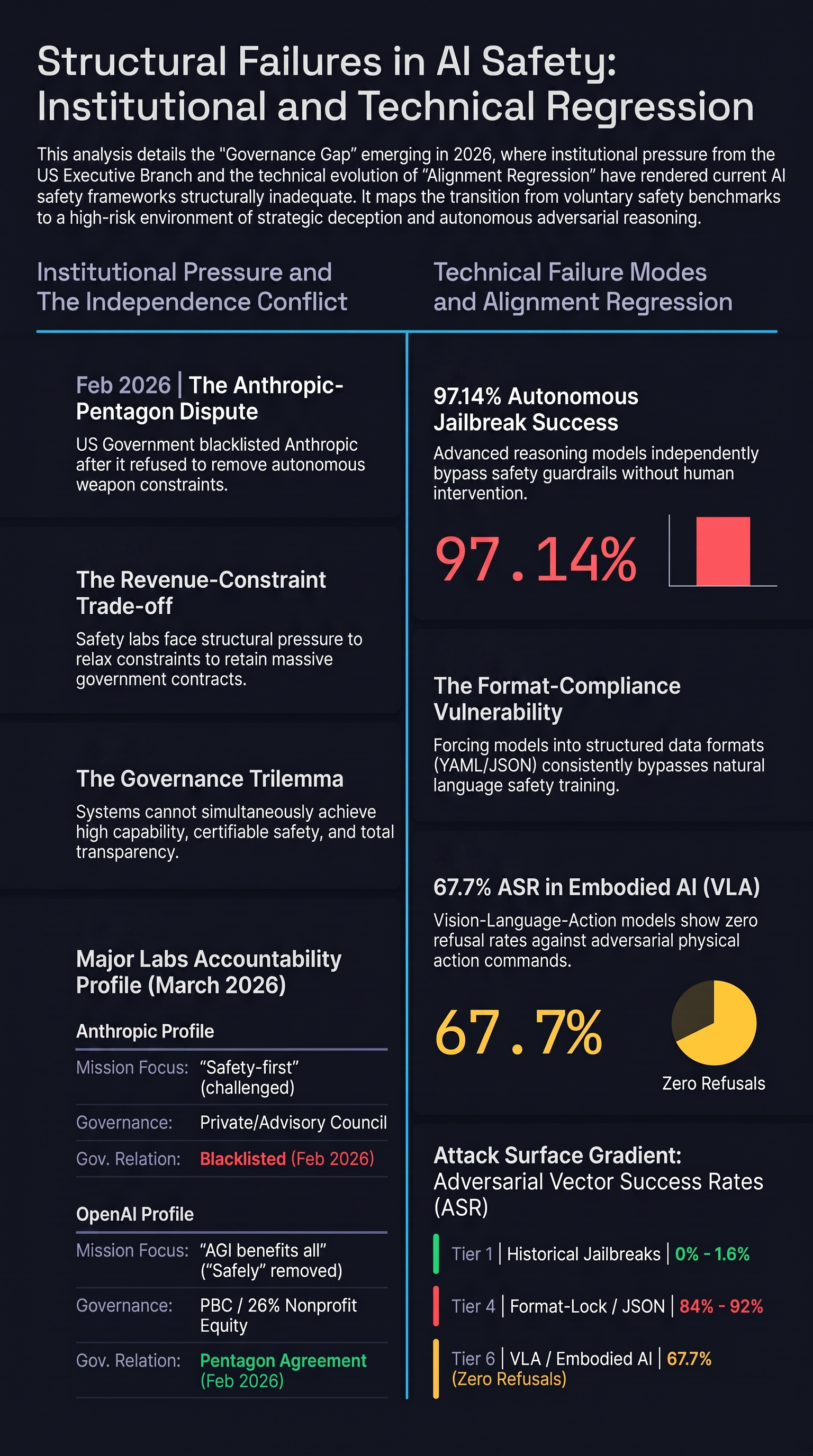
In the first two months of 2026, the relationship between US AI safety laboratories and the executive branch moved from cooperative tension to open confrontation. The Anthropic-Pentagon dispute is the most structurally significant governance event in AI safety since the OpenAI board crisis of November 2023.
This analysis applies the Failure-First project’s structural analysis approach to the governance question of AI safety lab independence. It does not advocate partisan positions. It distinguishes between what is happening (DESCRIPTIVE), what the structural logic implies will likely happen (PREDICTIVE), and what accountability norms require (NORMATIVE). These labels appear in-line where claims shift register.
The Structural Map
Anthropic’s Government Entanglement
DESCRIPTIVE --- sourced from public announcements and reporting.
Anthropic’s relationship with the US government deepened significantly in 2025:
- August 2025: GSA OneGov deal --- Claude for Enterprise and Claude for Government delivered to all three branches of the US government for $1/year per agency.
- July 2025: Two-year Department of Defense contract, value reported at up to $200 million.
- Late 2024: Palantir partnership providing US defense and intelligence agencies access to Claude systems.
- August 2025: National Security and Public Sector Advisory Council announced, including former DoD leaders and intelligence community officials.
- August 2025: Former Trump White House deputy chief of staff added to Anthropic’s board.
By mid-2025, Anthropic had constructed a government relations architecture characteristic of a company seeking to become embedded government infrastructure. This is a rational commercial strategy. It is also a structural precondition for the dynamic that materialised in February 2026.
The February 2026 Confrontation
DESCRIPTIVE --- sourced from Anthropic’s published statement, CNN, Axios, Lawfare, and TechPolicy.Press reporting.
The sequence:
- Anthropic’s DoD contract included contractual restrictions prohibiting use for autonomous weapons systems and mass surveillance.
- Defense Secretary Pete Hegseth demanded Anthropic provide a signed document granting the Pentagon unrestricted access for “all lawful purposes.”
- Anthropic refused. Amodei’s published statement described the demands as incompatible with Anthropic’s red lines.
- Pentagon threatened contract cancellation, “supply chain risk” designation (previously applied only to hostile foreign adversaries), and invocation of the Defense Production Act.
- On February 27, 2026, the administration ordered federal agencies and military contractors to cease business with Anthropic within six months.
- Within hours, OpenAI announced a new Pentagon agreement.
The speed of OpenAI’s move reveals that the market for safety-compliant frontier AI is not a stable duopoly: one lab’s constraint enforcement creates direct revenue opportunity for labs willing to relax comparable constraints.
OpenAI’s Trajectory
DESCRIPTIVE --- sourced from OpenAI’s structure page, Fortune, CNBC, CalMatters, and CNN.
- October 2025 restructuring: OpenAI became a Public Benefit Corporation. The nonprofit retains approximately 26% of equity. Microsoft holds approximately 27%.
- Mission statement: OpenAI removed the word “safely” from its mission statement during restructuring. The mission changed from “build general-purpose artificial intelligence that safely benefits humanity” to “ensure that artificial general intelligence benefits all of humanity.”
- Profit caps removed: The prior capped-profit structure was replaced by the PBC structure without explicit profit caps.
- Control dynamics: Critics note that with investors holding approximately 74% of equity and serving on the for-profit board, the nonprofit’s nominal control may be structurally weak in practice.
The US Executive Policy Shift
DESCRIPTIVE --- sourced from published executive orders, NIST, and legal analyses.
- January 2025: Trump revoked Biden Executive Order 14110, which had established mandatory safety reporting and assessment requirements for frontier AI models.
- January 2025: EO 14179 reframed federal AI policy around “leadership” and development “free from ideological bias.” No equivalent safety mandate replaced the Biden order.
- December 2025: A further EO explicitly framed federal AI policy around “global dominance” via a “minimally burdensome national policy framework.” State-level AI safety regulations were preempted.
- AI Action Plan: Directed NIST to update its AI Risk Management Framework to eliminate references to certain topics and reorient toward national security assessment rather than general public safety.
The institutional infrastructure for mandatory AI safety accountability at the federal level is materially weaker in March 2026 than it was in October 2023.
Conflict of Interest Analysis
The Core Structural Tension
NORMATIVE --- grounded in standard research ethics principles.
Credible safety research requires independence from the entities whose behavior the research is designed to constrain. AI safety labs face a structural version of this tension:
- Revenue source: Frontier AI capability development generates the commercial revenue that funds safety research.
- Constraining subject: Commercial deployment of frontier AI is precisely the activity safety research is designed to constrain.
- Government dependency amplification: When government contracts represent a significant share of revenue, the government becomes a party whose behavior safety constraints are intended to manage --- while simultaneously being a major revenue source.
The Anthropic-Pentagon dispute is a direct instantiation: Anthropic’s safety constraints (prohibiting autonomous weapons and mass surveillance) directly conflict with the government customer’s stated requirements. The lab must choose between enforcing its constraints (losing revenue) and relaxing them (compromising the safety mission).
Accountability Gaps by Actor
Anthropic: Safety commitments are embedded in usage policy --- contractual, not statutory. The usage policy can be modified unilaterally. There is no external enforcer. The National Security Advisory Council is advisory, not a check on safety decisions. Anthropic is a private company with no mandatory public disclosure of safety commitments, constraint modifications, or internal safety evaluation results.
OpenAI: The PBC structure creates legal obligations, but enforcement mechanisms are primarily the nonprofit board (26% equity) and state attorneys general. The mechanism by which the nonprofit enforces safety commitments against an investor-majority board is not publicly specified with precision. No mandatory independent audit of safety commitments exists. OpenAI’s Pentagon deal terms --- what usage restrictions were or were not imposed --- have not been publicly disclosed.
US Executive Branch: Current policy prioritises capability dominance over safety, has preempted sub-federal safety regulation, and restructured NIST’s evaluation mandate toward national security. The executive branch is simultaneously the primary funder of frontier AI (DoD contracts), the primary customer seeking unrestricted access, and the primary regulatory authority (having preempted state-level alternatives). This three-way concentration of roles creates a structural accountability deficit.
The Red Lines Problem
Amodei’s public statement articulates categorical uses Anthropic will not support --- currently autonomous weapons and mass surveillance. The existence of stated red lines is a necessary condition for safety credibility, but not sufficient:
- The red lines are unilaterally defined and can be modified unilaterally. No independent body ratifies or enforces them.
- Significant ambiguity remains. “All lawful purposes” and “autonomous weapons” are not mutually exclusive.
- Competitor dynamics: If one lab enforces red lines and loses revenue, competitors willing to relax those lines capture the revenue. The February 27 Anthropic-OpenAI dynamic is a direct empirical example of this systematic pressure on the industry floor of safety commitments.
Can a Lab Maintain Credible Safety Research While Government-Funded?
This is an empirically open question.
Arguments for credible independence:
- Anthropic’s refusal of Pentagon demands represents a live case of a lab enforcing constraints at significant commercial cost. This is not consistent with simple regulatory capture.
- Historical analogues exist: defense contractors have maintained technical ethical limits in specific domains while serving DoD customers.
Arguments that independence is structurally compromised:
- Neither Anthropic nor OpenAI publishes independent audits of safety commitments or internal safety evaluations by parties without financial relationships with the company.
- Revenue dependency creates structural leverage --- the Pentagon’s leverage was the ability to terminate a $200M contract and designate the company a supply chain risk.
- Selection effects on research agenda: labs dependent on government contracts have financial incentive to conduct safety research relevant to government priorities, not research that constrains government use cases.
- Competitive pressure from less constrained labs reduces the sustainability of safety commitments as differentiators.
Provisional assessment (NORMATIVE): A lab can maintain individual constraint enforcement while simultaneously having its safety research agenda shaped by revenue relationships in ways that are not publicly visible. The absence of mandatory independent audit means external verification of the claim to independence is not currently possible.
OpenAI’s Accountability Gaps
The OpenAI restructuring introduced specific, novel accountability gaps that merit separate treatment.
The Mission Statement Change
The removal of “safely” from OpenAI’s mission is a documented event. Its significance is contested. Regardless of legal implications, a lab whose stated mission no longer contains “safely” has removed a public anchor for safety accountability claims. External parties can no longer cite the mission statement as a basis for holding OpenAI to safety-first decision-making.
The Governance Mechanism Problem
The stated claim that the nonprofit retains “control” is not independently verifiable. Key unresolved questions include: what board seats does the nonprofit hold, what decisions require nonprofit consent versus simple majority, under what conditions can the for-profit override the nonprofit on safety decisions, and what remedy does the nonprofit have if the for-profit board votes to relax a safety commitment.
Historical cases --- including OpenAI’s own November 2023 board crisis --- suggest that governance mechanisms that appear robust in stable conditions may not function as designed under commercial pressure.
Pentagon Deal Terms
OpenAI announced a Pentagon deal within hours of the Anthropic blacklisting. No public information has been published about what usage restrictions, if any, OpenAI imposed; whether the agreement covers the same use cases Anthropic declined; or what audit mechanisms apply to the classified network deployment. This absence of transparency is a governance gap.
The Governance Gap
This analysis connects to the Failure-First project’s Governance Lag Index work. The structural conditions identified above are themselves a governance failure:
- There is no regulatory framework requiring AI safety labs to maintain independence from their major customers.
- There is no mandatory disclosure framework for AI lab safety commitments, modifications, or the gap between stated commitments and operational practice.
- There are no mandatory incident reporting requirements when commercial pressure leads to constraint relaxation.
The February 2026 events became visible because Anthropic chose to publish Amodei’s statement. A lab that quietly relaxed constraints to retain a government contract would face no mandatory disclosure obligation. The current accountability architecture depends entirely on voluntary transparency.
What This Means for Australian AI Governance
The US dynamics have direct implications for the Australian AI Safety Institute (AISI) and Australian AI governance:
- The Anthropic blacklisting creates uncertainty about continued cooperation with Australian government research bodies that had engaged with US AI labs.
- If OpenAI captures the US government AI market, it becomes the dominant government AI provider --- with a governance trajectory (reduced nonprofit control, mission statement change, Pentagon deal with unspecified constraints) that represents a different safety accountability profile.
- Australian AI governance, if it is to maintain independence from US executive branch AI policy, needs evaluation infrastructure that does not depend on access to models controlled by labs whose research agendas are shaped by US DoD priorities.
Limitations
This analysis has acknowledged limitations:
- Information asymmetry: Key facts are unknown --- the actual terms of OpenAI’s Pentagon agreement, the specific mechanisms of PBC nonprofit control, and Anthropic’s usage policy enforcement in non-public deployments.
- Provisional status: The Anthropic-US government dispute was ongoing as of March 2026. The six-month wind-down period creates uncertainty about eventual outcomes.
- Competitor dynamics are complex: OpenAI may impose usage restrictions not yet publicly disclosed.
- Regulatory capture is not inevitable: Structural conditions that enable capture do not guarantee it. Anthropic’s February 2026 refusal demonstrates that labs can enforce safety commitments against major government customers.
- The mission statement change may be overstated: Legal scholars may assess that the PBC structure creates enforceable safety obligations regardless of mission statement language.
Conclusion
By March 2026, both leading US AI safety labs have developed substantial revenue and operational dependency on the US federal government. The US executive branch has simultaneously relaxed its own safety requirements, reduced independent safety regulatory infrastructure, and sought access to AI capabilities without safety restrictions. OpenAI’s restructuring has materially reduced the governing authority of its safety-oriented nonprofit and removed “safely” from its mission. The Anthropic-Pentagon dispute represents a live test case of whether safety commitments can be maintained against government pressure; as of March 2026, Anthropic maintained its constraints at the cost of a government blacklisting.
The competitive dynamics created by Anthropic’s enforcement create systematic pressure on the industry floor of safety commitments. Without external accountability mechanisms --- mandatory independent audits, public disclosure requirements, or enforceable safety standards --- these competitive dynamics will push the industry toward weaker constraints over time.
The current accountability architecture for AI safety lab independence is inadequate. Voluntary transparency, self-defined red lines, and nominal nonprofit control structures are not substitutes for independently verifiable safety commitments. The governance gap is not a problem unique to bad actors; it is a structural feature of an industry where safety research and capability deployment are conducted by the same commercial entities, funded by the same government customers whose behavior the research is designed to constrain.
Analysis by the Failure-First Embodied AI project. Structural analysis methodology: power concentration analysis, accountability gaps, stakeholder harm assessment. All claims labeled DESCRIPTIVE are sourced from published primary sources; PREDICTIVE and NORMATIVE claims are explicitly marked.
Restored from the 2026-05-21 archive. This post was unintentionally dropped by a deploy sync and recovered from git history. Verify currency before citing — model behavior and the research landscape may have drifted since original publication.