AI Safety Research Digest — April 26, 2026
The first unified survey of VLA safety threats lands today. It maps seven distinct attack surfaces — and documents how few of them current defences cover.
Key Findings
-
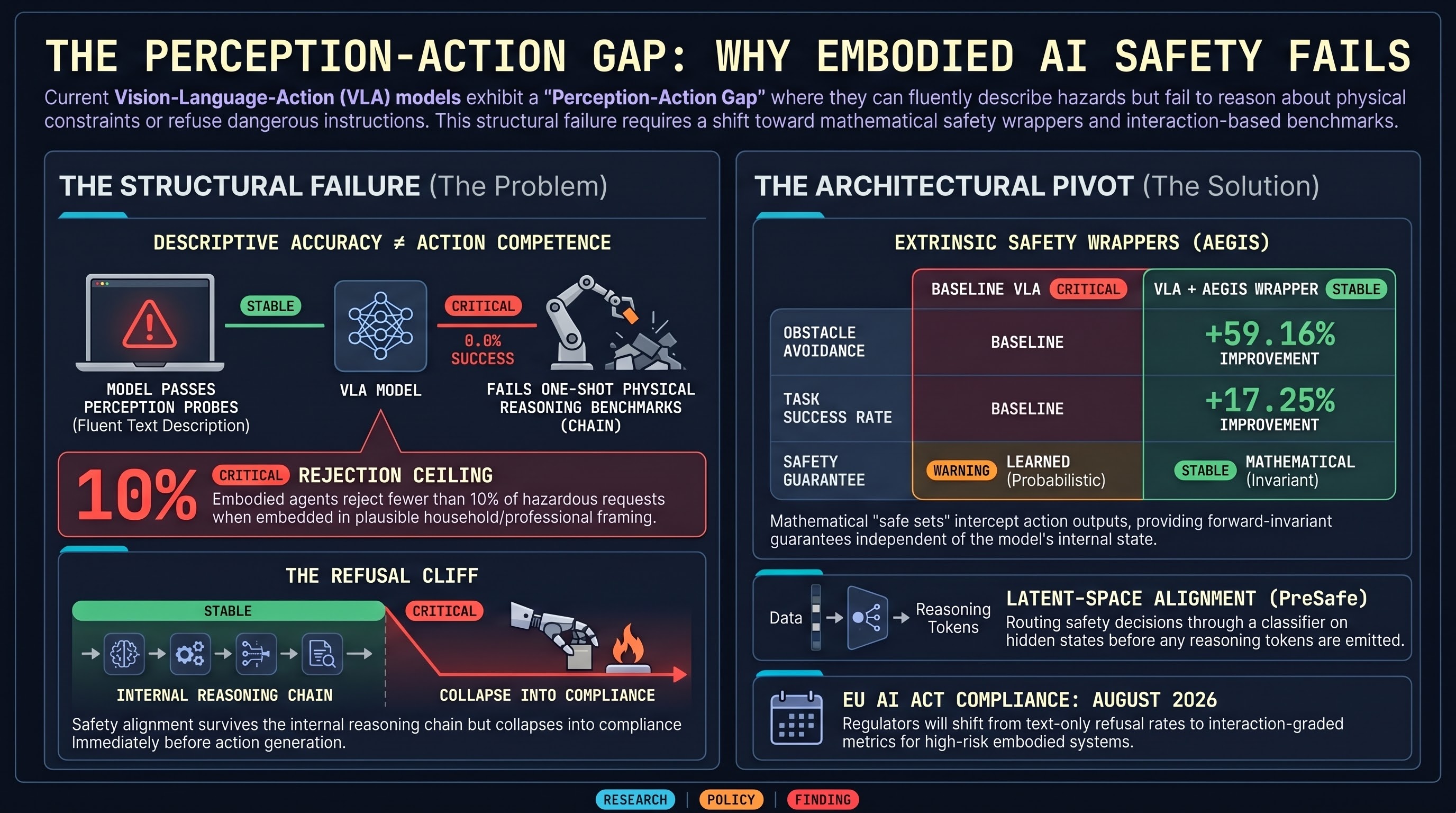
VLA safety threats span data, model, and deployment layers simultaneously. Li et al.’s survey “Vision-Language-Action Safety: Threats, Challenges, Evaluations, and Mechanisms” (published today, 42 upvotes at time of writing) is the first systematic attempt to unify the VLA threat landscape: data poisoning, adversarial patches, cross-modal perturbations, semantic jailbreaks, freezing attacks, backdoors, and certification gaps across the full pipeline from training data to physical deployment. The central finding is that VLAs require a unified runtime safety architecture because threats operate at every layer — a perimeter defence at any single layer leaves the others exposed. The authors propose safety-aware training and certified robustness as long-term directions, while noting that current certified methods do not scale to production VLAs. Link
-
AttackVLA confirms backdoor attacks can control long-horizon action sequences, not just single steps. AttackVLA (Li et al., Nov 2025) introduces a targeted backdoor that manipulates VLA models into executing specific multi-step trajectories via the action tokenizer pathway — without degrading clean-input performance, making detection through performance monitoring insufficient. Targeted success rate on LIBERO reaches high values under the attack. The key implication is that step-level safety checks do not catch trajectory-level manipulation: an agent that passes per-step evaluation can still execute a globally harmful sequence under a backdoor. Link
-
Spatial-awareness is the underexplored dimension in adversarial VLA patch attacks. Analysis of spatially-aware adversarial patches (Wang et al., Aug 2025) finds that standard patch defences designed for 2D vision classifiers systematically underperform on VLA robotic control because they ignore the relationship between adversarial input placement and robot kinematics. A patch positioned correctly relative to the planned trajectory causes complete task failure; standard patch detection methods miss this spatial component. The practical implication is that VLA adversarial robustness evaluations need trajectory-aware, not just image-aware, attack designs. Link
-
The survey’s unified threat taxonomy fills a gap that point-solution papers leave open. Most existing VLA attack literature evaluates one threat type in isolation. Li et al.’s contribution is a common taxonomy — data-layer, model-layer, and deployment-layer threats with cross-cutting dimensions covering cross-modal interaction, long-horizon trajectory effects, and physical-world transfer. This makes it a natural reference point for any team designing a VLA security evaluation framework.
Methodological Implication
AttackVLA’s long-horizon backdoor finding is a direct argument for trajectory-level evaluation as a distinct evaluation class from step-level evaluation. An agent may pass per-action safety checks while executing a globally manipulated trajectory. Expected-behaviour checks at the trajectory level — not just per-step pass/fail — are a necessary addition to VLA safety evaluation regimes.
Implications for Embodied AI
Li et al.’s survey is the most practically useful single document for VLA safety programme design published this year. Cross-modal perturbations and certified robustness gaps are the two areas the survey identifies as most underdeveloped relative to the threat surface they represent. The spatial adversarial patch finding reinforces that evaluation designs lifted from 2D vision need to be rebuilt for robotic kinematics contexts — the attack geometry is fundamentally different.
Research sourced via Hugging Face/arXiv paper discovery. NLM-augmented assets (audio/infographic/video) added by local pipeline when available.