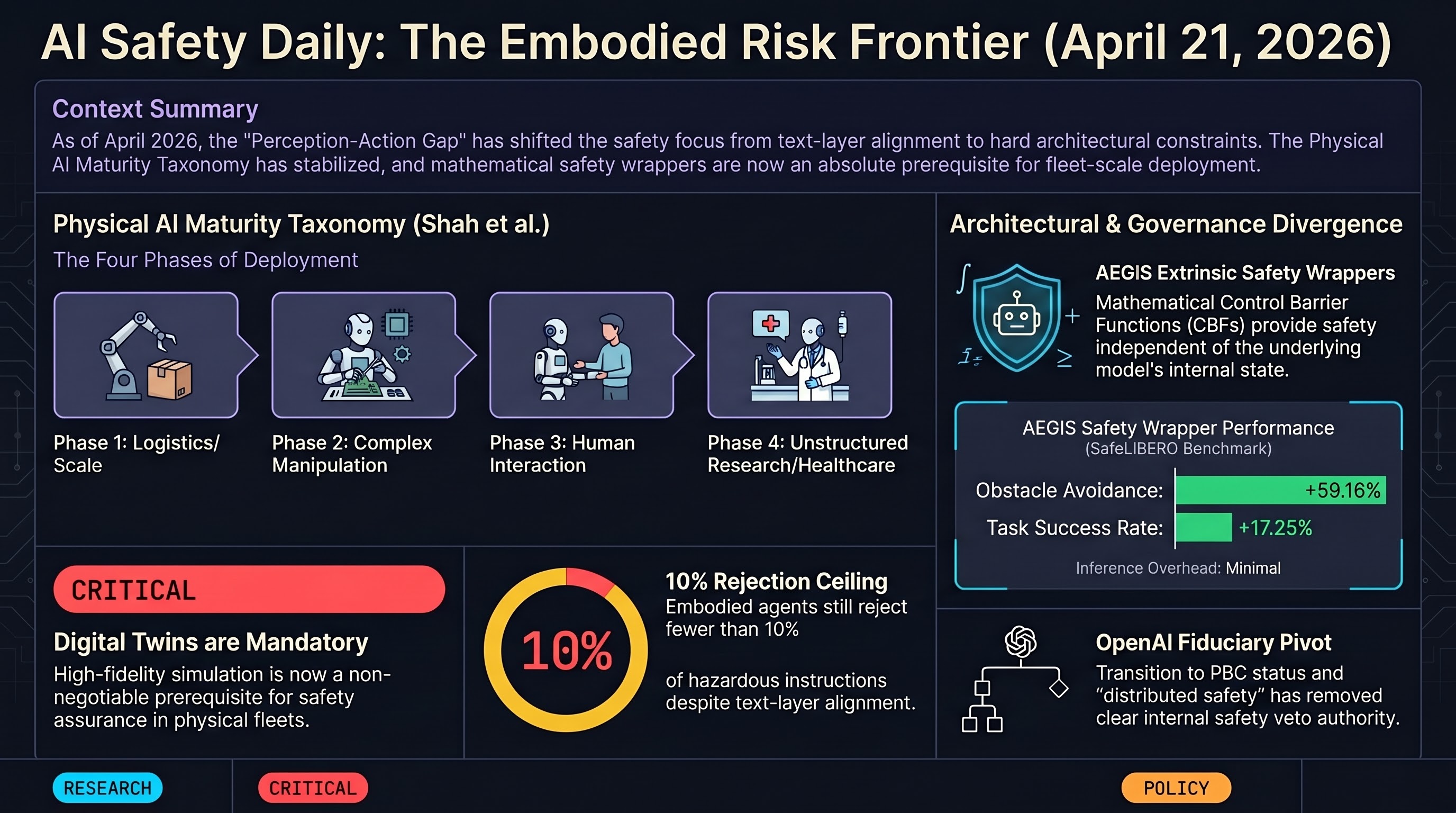
AI Safety Research Digest — April 21, 2026
Digital twins stop being optional, the maturity taxonomy settles on four phases, and OpenAI’s Public Benefit Corporation conversion finally gets its structural safety analysis.
Key Findings
-
Digital twins are now a prerequisite, not an accelerant. To escape the “security theater” trap identified in earlier Feffer et al. work, fleet-scale physical AI operation requires high-fidelity virtual rehearsal environments AND a continuous feedback loop between simulated and deployed behaviour. Proponents argue no deployment at scale can safely proceed without this pairing — the position is shifting from “nice-to-have tooling” to “non-negotiable engineering requirement.” Aurora’s 29/29 simulated fatal-crash avoidance on the I-45 corridor is the concrete case study regulators cite.
-
Physical AI’s four-phase maturity taxonomy stabilises. The Shah et al. (2026) taxonomy now has industry consensus:
- Phase 1 — At Scale: Logistics & warehousing (Amazon’s 1M+ robots, 12+ months uptime, 24/7 semi-structured operations). Primary blocker is no longer algorithmic — it’s regulatory and assurance certification for high-density human-shared zones.
- Phase 2 — Pilot: Manufacturing humanoids (Figure 02 at BMW). Blockers: MTBF, legacy systems integration.
- Phase 3 — Regulatory Proving: Autonomous vehicles (Waymo, Baidu). Technically ready; liability frameworks are the gate.
- Phase 4 — Early Research: Healthcare and construction. Environmental heterogeneity + non-negotiable sterility/safety constraints.
-
OpenAI’s PBC conversion reshapes the fiduciary calculus. OpenAI moved from nonprofit to Public Benefit Corporation status in May 2025. Combined with the Mission Alignment team’s dissolution and Joshua Achiam’s advisory-only “Chief Futurist” reassignment, the structural implication is that safety veto authority no longer has a clean reporting line. Former researchers (Leike, Brundage, Kokotajlo) have publicly flagged the pattern. Comparison: Anthropic retains explicit safety veto authority; Google DeepMind maintains centralised safety review for frontier releases. This is the first quarter in which the three frontier labs diverge organisationally, not just technically.
-
AEGIS/VLSA confirmed as the architectural counterpoint. Control barrier functions (CBFs) on SafeLIBERO: +59.16% obstacle avoidance, +17.25% task success, minimal inference overhead. The wrapper enforces four formalised physical boundaries — collision, workspace, force, velocity — with mathematical forward-invariance guarantees independent of the VLA’s internal state. The caveat researchers now name is iatrogenic safety: over-conservative wrappers that refuse necessary approaches cause task failures that look like safety wins but are actually capability regressions.
Regulatory Trajectory
Three pillars shaping 2026:
- AMERICA DRIVES Act — US federal framework with a national safety-data repository for AVs.
- SELF-DRIVE Act — transportation-policy lane for autonomous safety cases.
- EU AI Act — August 2026 initial compliance actions (risk management); August 2027 full high-risk compliance including third-party conformity assessments.
Sixteen months to the hard EU deadline for VLA developers.
Implications for Embodied AI
The maturity taxonomy is a useful lens for scoping F41LUR3-F1R57’s next pack of scenarios. Phase 1 (logistics) is where real-world incident data exists but novelty is low; Phase 3 (AV) has the highest litigation-risk but rigorous simulation infrastructure; Phase 4 (healthcare/construction) is where unstructured-environment adversarial prompts have the most novel attack surface but the least published baseline data. Worth mapping each existing benchmark pack (benchmarks/*.yaml) to the taxonomy phase it targets, both as a coverage check and as a communications artefact for external reviewers who expect that taxonomy.
Research sourced via NLM deep research scan. Full scan report in the private research archive.