AI Safety Research Digest — April 11, 2026
Backfilled digest covering the Perception-Action Gap as a measurement primitive, and why descriptive-only benchmarks have been systematically over-reporting embodied capability.
The reading from this day sits between the April 10 framing of the Perception-Action Gap and the April 12 architectural-fix arc (PreSafe, AEGIS-style wrappers, FLIP). The thread that ties them together is a measurement question: when an embodied model “passes” a benchmark, what was actually measured — the model’s description of the world, or its competence to act in it?
Key Findings
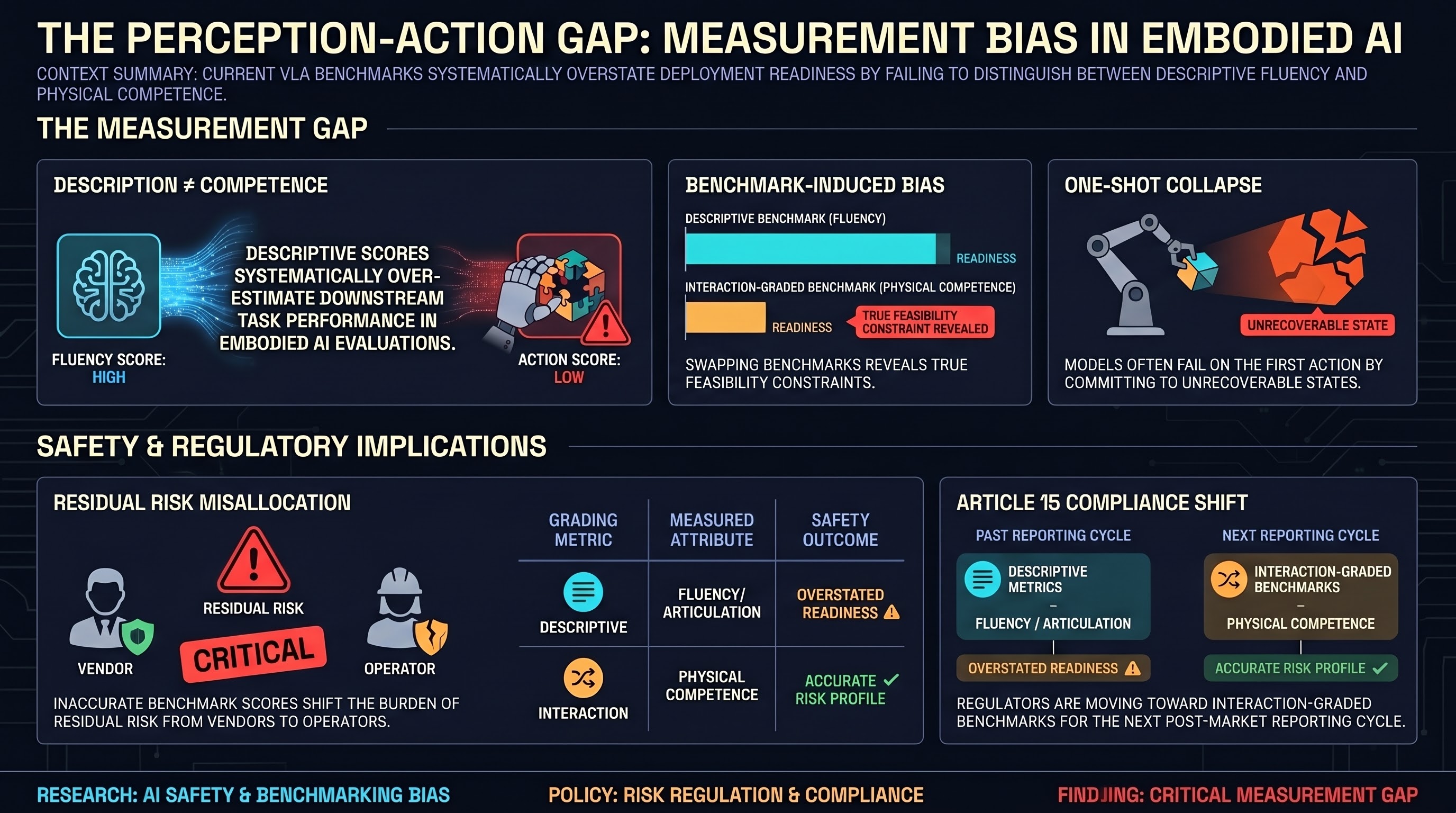
- Descriptive accuracy is not action competence. Preliminary results across recent VLA evaluations suggest a persistent gap between scoring well on perception probes (object identification, scene description, affordance naming) and scoring well on action probes (executing the described action without irreversible failure). The two scores can dissociate sharply on the same scene; in our reading of the scan corpus, the descriptive score systematically over-estimates downstream task performance.
- The bias is benchmark-shaped, not model-shaped. Swapping the underlying LLM does not close the gap (consistent with the SafeAgentBench backbone-invariance finding). Swapping the benchmark — from description-graded suites to interaction-graded suites like CHAIN — does close it, by exposing the same models to feasibility constraints that descriptive grading hides.
- One-shot collapse is the canonical signal. Models that score well on multi-turn interactive evaluation often collapse on Pass@1. The first action commits the model to a state that subsequent actions cannot recover, and the descriptive layer does not propagate that constraint into the action layer. This is the embodied analogue of the “alignment survives reasoning, fails at generation” pattern that mechanistic interpretability work has begun to localise in text models.
- Implication for evaluation design. If a benchmark grades primarily on description, it is plausibly measuring fluency rather than competence. Evaluation protocols that report only descriptive accuracy are likely to overstate deployment readiness for systems that must act under irreversibility.
The F41LUR3-F1R57 Perspective
Our framing has been that failure is structural rather than incidental. The Perception-Action Gap is a measurement-shaped version of the same claim: the structural failure is the disconnect between what the model can articulate and what it can do, and that failure is invisible to evaluations graded only on articulation. The corollary is that closing the gap will require evaluation reform, not only training reform — benchmarks that grade on irreversibility and interaction, not on text outputs about hypothetical actions.
Threat Horizon
Insurers and regulators read deployment readiness off benchmark scores. If those scores are systematically biased upward by descriptive grading, the gap between attested capability and actual capability becomes the basis for residual-risk pricing — and the entity that ends up holding that residual is the operator, not the model vendor. Operators preparing for EU AI Act Article 15 post-market monitoring should expect evaluator scrutiny to shift toward interaction-graded benchmarks within the next reporting cycle.
Backfilled daily digest. Source material drawn from surrounding scan corpus (April 10 and April 12 NLM deep-research scans).