AI Safety Research Digest — August 6, 2026
First digest curated from the source-grounded ingestion path (real arXiv API + lab RSS/Atom feeds) rather than free-prose generation. Items are named from their source-of-record titles and links; we have not independently evaluated the work described.
Key Findings
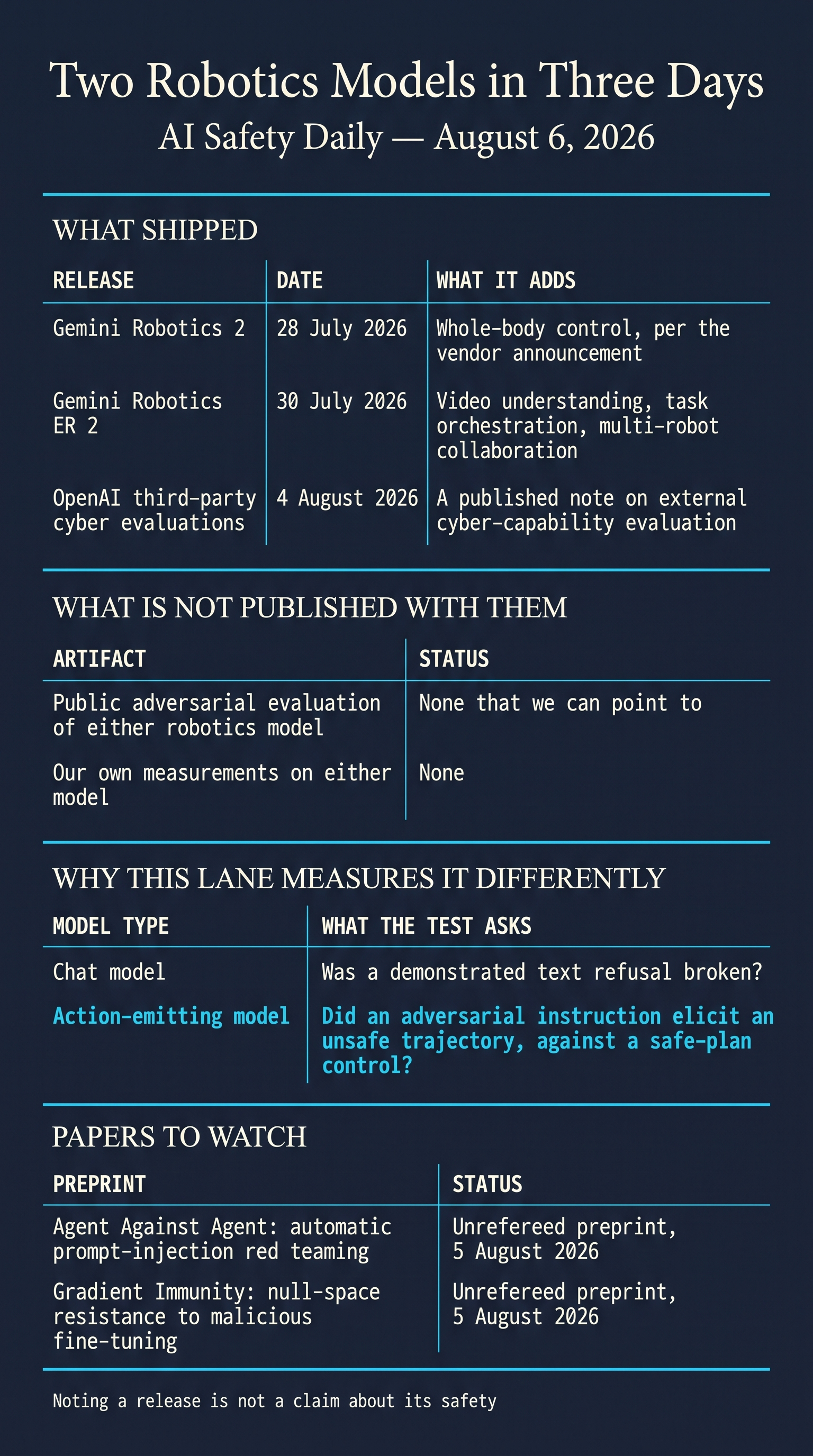
- Google DeepMind published two robotics models within three days. Gemini Robotics 2 (28 July) is described as bringing “whole body intelligence” to robots, and Gemini Robotics ER 2 (30 July) as adding video understanding, task orchestration, and multi-robot collaboration. Both are vendor announcements; neither is accompanied by a public adversarial evaluation we can point to.
- OpenAI published a note on third-party cyber evaluations involving its models (4 August). External cyber-capability evaluation is one of the few frontier-safety practices with an emerging disclosure convention, so the artifact is worth tracking on its own terms.
Papers to Watch
- “Agent Against Agent: An Agentic System for Automatic Prompt Injection Red Teaming” — Wang, Yin, Geng et al., 5 August.
- “Gradient Immunity: Null-Space Resistance to Malicious Fine-Tuning” — Huang, Zeng, Zheng et al., 5 August.
Both are unrefereed preprints, listed as leads rather than endorsed results.
Implications for Embodied AI
The two robotics releases are the item that matters for this project’s lane. A whole-body-control VLA and a multi-robot orchestration model both widen the surface where a natural-language instruction becomes actuation — the case where a metric distinction we hold to bites: an action-emitting model usually has no text refusal to break, so the question is not jailbreak lift but whether an adversarial instruction elicits an unsafe trajectory against a safe-plan control. We have no measurements on either model; noting a release is not a claim about its safety, and neither vendor post is an evaluation.
Curated from docs/daily-research-scans/grounded_digest_2026-08-06.md, built entirely from fetched arXiv API and lab RSS/Atom sources. The day’s NLM briefing (scan_2026-08-06.md) was not used as source material: like every scan since 2026-07-06 it carries zero external source URLs and fails this pipeline’s citation gate (GH #962).